
History
During an outreach clinic in rural Zambia, a donkey was presented who had been lying recumbent on the edge of a village road. He was dull, cold to the touch and unable to stand without assistance. His owner explained that the donkey had been heavily infested with ticks. Wanting to help, he had treated him with a concentrated amitraz-based acaricide he normally used on cattle. He showed us the bottle immediately, unaware that the dose and formulation posed a serious toxic risk to donkeys. Within a few days of the treatment, the donkey had stopped eating, become progressively lethargic, and eventually collapsed.
Clinical examination
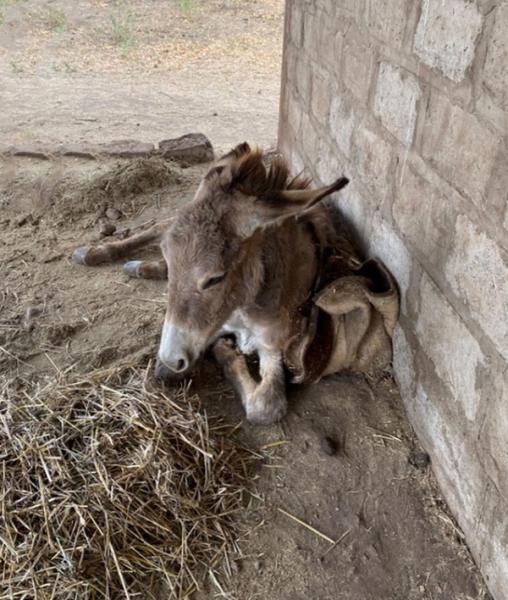
The donkey was lethargic and recumbent, and he was minimally responsive to stimuli (figure 1).
- Heart rate was low at 36 bpm
- Respiratory rate 32 breaths per minute
- Temperature 35.5°C
- Mucous membranes were pale and dry
- Capillary refill time was 3 seconds
- Gastrointestinal sounds were reduced in all quadrants
The history and clinical signs were strongly consistent with amitraz intoxication. Amitraz is a potent insecticide and acaricide which activates alpha-1 receptors centrally and alpha-2 adrenergic receptors peripherally. These properties are similar to sedatives and can cause profound central nervous system depression, cardiovascular compromise, gastrointestinal ileus, and metabolic instability in equids.


Initial treatment
Emergency stabilisation was performed on-site before the donkey was transported to hospital facilities. This consisted of:
- A rapid intravenous fluid bolus of 3 litres of normal saline for cardiovascular support
- Flunixin meglumine at 1.1mg/kg for inflammation and analgesia
- Dexamethasone at 0.1mg/kg
Once he was stable enough to move, he was transferred for continued care with careful padding to relieve the pressure points during transport.
Ongoing care
During hospitalisation, his treatment was fully supportive. He remained weak and recumbent, and was given further fluid therapy including lactated ringers and 5% dextrose solution as boluses, due to the lack of facilities to provide continuous intravenous fluid support. Intensive nursing care included: regular turning, padding, wound care for his developing sores, and hand-feeding (via syringe) to maintain energy intake. Syringe feeding used a mixture of ground oats, honey, grated carrot and apple with salt, multiple times a day.
Grass and hard feed were offered but rarely eaten. His cardiovascular parameters remained unstable with bradycardia. He received one dose of atropine at 0.1mg/kg. Ideally, he would have been treated with Yohimbine, an alpha-2 antagonist that is known to reverse symptoms of amitraz, but the drug was not available anywhere in Zambia at the time, limiting the ability to treat him.
Throughout this period of hospitalisation the donkey’s quality of life was monitored through continuous, close observation on a 24/7 basis. Parameters assessed included appetite and food intake, water intake, faecal output and consistency, general behaviour and responsiveness, posture, and overall comfort. Particular attention was paid to ensuring that he remained clean, well bedded, and positioned in a way that minimised the risk of pressure sores or secondary wounds.

Outcome
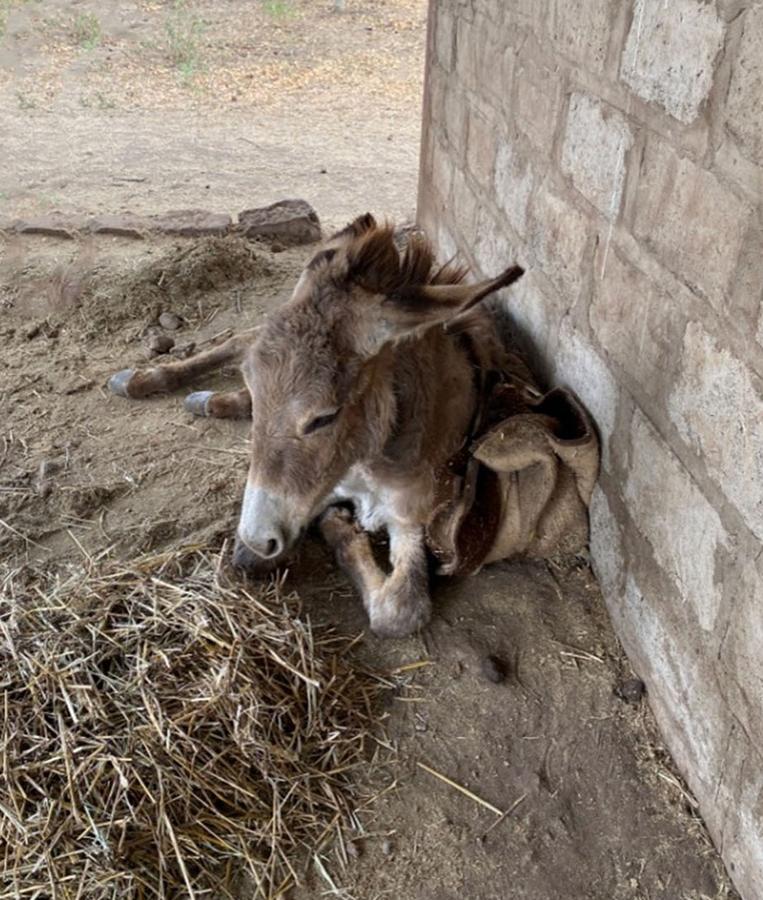
After several days, he showed brief moments of improvement (figure 2), lifting his head or responding to handling, but these periods were never sustained. His clinical parameters had improved to HR 44 bpm, RR 24 bpm, T38.2 but despite ongoing fluid therapy, assisted feeding, and wound management, his clinical status remained unstable and he remained poorly responsive and depressed.
The decision for euthanasia was taken after several days without any meaningful clinical improvement. Sadly, despite supportive care, there was no progression toward regaining normal mentation or functional neurological responses. At that point, it became clear that continued waiting was unlikely to change the outcome, and that prolonging his life risked moving from supportive care into prolonged suffering without realistic benefit.
This decision was also influenced by the limitations in available resources. Advanced intensive care options, prolonged specialised neurological support, and further diagnostics or treatments were not realistically accessible in this context. Given the lack of improvement, the poor prognosis, and the constraints on what could ethically and practically be offered, euthanasia was considered the most humane option and in the best interest of the animal.
The owner consented to euthanasia which was performed under a general anaesthetic. The donkey had an intravenous catheter placed and was sedated with xylazine at 1.1mg/kg intravenously, then anaesthesia induced with a bolus of ketamine at 2.7mg/kg. Following this a supersaturated solution of magnesium sulphate was infused until euthanasia occurred.
Community training
Following this an educational session was held within the community to address safe parasite control in donkeys, proper dosing, and the dangers of using concentrated cattle products on equids. The owner actively participated and encouraged others to learn from the experience. His honesty and willingness to engage illustrated a widespread challenge: caregivers acting with good intentions but limited access to veterinary guidance.
Discussion
Tick borne disease in equines can be a serious issue with ticks spreading a number of diseases, including Babesia species, leading to anaemia and weakness in naive individuals. There are safer products to remove ticks from equines including permethrins and physical removal. Exposure to amitraz in all equines via ingestion, inhalation or contact can cause bradycardia, reduced cardiac output, hypotension, bradypnoea, hypothermia, ileus, colic and central nervous system depression which can lead to coma or seizures.
Gupta and Dross [1] note that amitraz poisoning is seen in small animals where dogs chew insecticide impregnated collars, or cats are exposed to the chemical. Amitraz is lipophilic and highly absorbed orally or though the skin, which is the method of toxicity seen in this case and in the case reports discussed below.
Immediate decontamination by washing with soap can be useful in contact toxicity situations, or attempting to remove ingested amitraz using liquid paraffin or activated charcoal by stomach tube in equines prior to absorption. The specific antidote yohimbine (an alpha-2 adrenergic antagonist) can be used at 0.05mg/kg IV BID if available, which is often not the case. Atipamezole (0.05-0.2 mg/kg slow IM) is also an alpha-2 antagonist that has been used in other species to treat amitraz toxicity [2, 5]. There are no reports of its use in the horse or donkey for amitraz toxicity.
Supportive therapy has proven successful in some case reports with similar regimes to those presented here. The concentration and amount of amitraz was not determined in this case, and proved to be a fatal dose. The team provided high quality welfare treatment and support to this donkey but also made this case into a learning experience for the community so that future donkey deaths could be avoided.
Other case reports
Auer et al in 1984 [3] reported on a series of 3 horses that became ill after topical application of 0.025% w/v aqueous solution of amitraz. Some of the solution was old and likely to have decayed to even more toxic formamidine derivates. The horses became depressed, ataxic and developed impaction colic, with dehydration. In this case series only supportive therapy was provided consisting of intravenous fluids, liquid paraffin, analgesia and dexamethasone, and all horses survived.
Phetudomsinsuk et al, 2014 [4] reported on the case of a single Thoroughbred horse who was treated with topical amitraz two days previously, and required hospitalisation for depression and colic. In this case yohimbine was available as well as supportive therapy, which included fluids and atropine to improve the bradycardia. The authors noted that yohimbine brought about reversal of the clinical signs of depression and ileus within 24 hours of use, even though it was not given to the patient until day 3 of treatment. The horse survived and recovered completely with three days of the yohimbine treatment.
Key points
- Horses and donkeys must not be treated with cattle and sheep parasiticides, especially if they contain amitraz
- Immediate decontamination is vital via washing off topical products or gastric lavage if ingested
- Supportive therapy aims to counteract the toxin by promoting gastrointestinal motility and fluid and nutrition intake
- Community education to prevent such episodes is vital