

Overview
Fleas are a common cause of pruritus in dogs and cats, predisposing to secondary bacterial skin disease and chronic dermatological conditions. There are many species and they are not host specific so can cross-infect cats and dogs, with Ctenocephalides felis being the most common in both dogs and cats and Ctenocephalides canis being less common. Clinical signs are generally mild, however fleas present a welfare concern, predispose for the development of hypersensitive skin disorders and are zoonotic to people. In small and young patients severe infestations can cause life-threatening anaemia.
Lifecycle
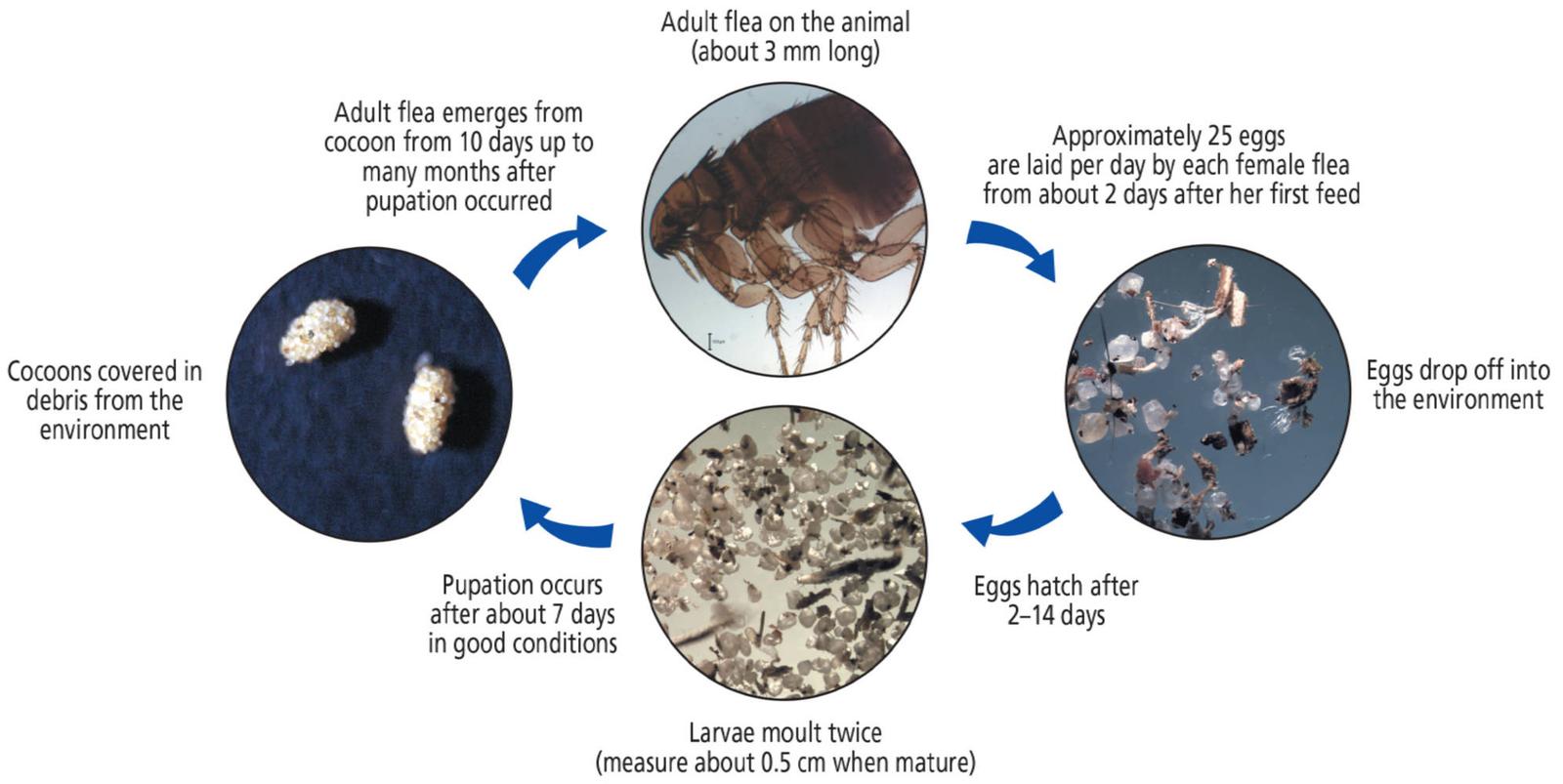
Adult fleas live on the host, where they lay large numbers of eggs, which fall into the environment in areas where the animal spends most time. Adults can only survive in the environment for short periods of time in the absence of a host. Larvae hatch from eggs after 1-10 days. Larvae are susceptible to desiccation; they feed on debris, flea faeces and may ingest the segments of Dipilydium caninum (tapeworm intermediate host). After 5-11 days the larvae develop into pupae. Pupae are environmentally resistant and can survive in the environment for prolonged time periods, up to 6 months. Pupae emerge into adult fleas in response to rising ambient temperature and humidity. Adult fleas then seek a host for a blood meal.
Clinical signs
Generalised pruritus
Adult fleas and flea dirt (flea faeces) seen in coat.
Chronic infestation of fleas in dogs may result in development of type I and IV hypersensitivity reaction (Flea Allergic Dermatitis) to flea saliva resulting in more severe clinical signs associated with the associated inflammatory response:
- Intense pruritus often focussed around the dorsum, tail base and ventral abdomen
- Hair thinning and loss
- Papules and crusts in the coat
- Self-trauma resulting in worsening skin lesions and occasionally secondary bacterial skin infections.
In young puppies, severe flea infestations can result in life-threatening anaemia due to blood loss.
Diagnostic investigations
Grossly visible adult fleas and flea dirt (flea faeces) in the coat or on flea combing of the coat, however adult fleas are sometimes absent due to removal from the coat by animal's grooming activity.
Wet paper test - Hair coat combing onto white damp paper will show red marks as flea faeces disperse.
Microscopy of fleas will enable confirmation of species, however this is of little clinical relevance.
Treatment
Fipronil topical preparation:
- 0.25% cutaneous spray 3-6ml/kg to dampen coat to the skin applied at 2-monthly intervals
- 0.25% cutaneous spray licensed for use in puppies from 2 days old
- 10% Fipronil spot-on solution. Dose according to bodyweight. Part the hair on the back of the neck and apply topically directly onto the skin every 4 weeks. Only use in puppies > 8weeks old and dogs > 2kg
Imidacloprid spot-on solution 10mg/kg applied topically. Part the hair on the back of the neck and apply directly to the skin every 4 weeks.
Selamectin spot-on solution. 6mg/kg applied topically. Part the hair on the back of the neck and apply directly to the skin every 4 weeks.
Other topical products (suitable for dogs and cats) containing moxidectin, indoxacarb, dinotefuran/pyriproxyfen, pyriprole (dog) and oral products containing afloxolaner (dog), fluralaner (dog) and spinosad.
Tapeworm treatment - Dogs with flea infestation should also be treated appropriately for tapeworm (Dipilydium caninum) with Praziquantel containing anthelmintic.
Flea Allergic Dermatitis - For dogs susceptible to Flea Allergic Dermatitis, rigorous flea control is required including all pets sharing the living space and appropriate treatment of the environment. Short-acting glucocorticoids may be helpful in reducing associated intense pruritus and self-trauma, while the infestation is cleared. Appropriate antibiosis should be considered for cases with concurrent secondary skin infection.
Prognosis
Infestations may take several months to be cleared due to the environmental pupae stage of the life cycle.
Prevention
Regular prophylaxis of all animals in a shared environment with and appropriate treatment is essential to clear infection and prevent reinfection.
Treatment of the indoor environment with an appropriate product to reduce the flea egg and pupae burden.
Washing of pets’ bedding regularly to reduce environmental life cycle stages.
Vacuuming of pets living area to reduce eggs and environmental life cycle stages.
Links
Further information on this subject is available on the ESCCAP website.