

As with all surgical cases, the patient should be monitored for signs of post-operative complications, especially swelling of the surgical site, wound discharge and dehiscence. Wherever possible routine physical examinations should be performed twice daily with additional visual checks, as well as assessment of appetite and drinking.
During high-throughput spay-neuter initiatives, it is often necessary to operate on stray and semi-owned dogs. The timing of release will depend on assessment of the local situation, but should consider the temperament of the dog, its degree of dependency on people, and the ability of the community to monitor and report post-operative complications. The community should be made aware of when sterilisation will take place in their area, what signs to look out for in operated dogs and be given details of a direct phone number to report any concerns. The pre-release assessment is a critical time to evaluate an animals fitness for release. Animals must not be released if there are any concerns at all regarding their general health or the surgical wound.
Analgesia protocol
Pain relief is necessary for the patient in the days after surgery. During this time, the surgical wound will be tender and effective analgesia serves to ensure that the patient is not in discomfort. Pain can have a negative effect on recovery, and may cause the animal to lick the wound or damage the stitches, thereby increasing the risk of post-operative complications.
Meloxicam at a dose of 0.1mg/kg SC every 24 hours can be given for up to 4 days post-surgery. As a minimum, it should be given on at least for the first day post-operatively.
Wound scoring
Wound scoring assesses the healing of surgical wounds; it is an effective way of monitoring progress of healing, and detecting post-operative complications early, thereby minimising the impact on the animal. In addition, it provides an indication of the effectiveness of a surgeon's skills and helps highlight and improve practices where needed. For free-roaming animals in a spay-neuter setting, it is imperative that your surgical outcomes are positive so that patients can be released with confidence that they will recover well.
A wound scoring system based on a scale of 0 to 5 is used at our International Training Centres and is shown below.
Subjective scoring system for surgical wounds
Ideally the wound should be scored once a day for 3-days post-surgery. If, at 3 days post-surgery, the wound is a score either 0 or 1, then the patient is ready for release or discharge.
Score 0: Perfectly healing wound; edges in apposition. Can be released.
Score 1: Mild redness on the edges of the incision; no discharge. No need for intervention; can be released.
Score 2: Swelling or discharge on exposed subcutis. redness and swelling or discharge from the wound; minor intervention required (wound cleaning). Continue NSAIDs; not to be released yet.
Score 3: Partial opening of the skin and exposure of subcutaneous and/or muscle layers; major intervention required (wound cleaning AND re-suturing). Consider if antibiotics are needed; not to be released yet.
Score 4: Complete opening of the skin and subcutaneous tissue; major intervention required (wound cleaning and re-suturing). Start systemic antibiotics; not to be released yet.
Score 5: Complete opening of all the three layers, intestines exposed. Major intervention and emergency care required, prognosis is poor.
An example of wound scores 0, 1 and 2 are shown below (Figures 1-3).
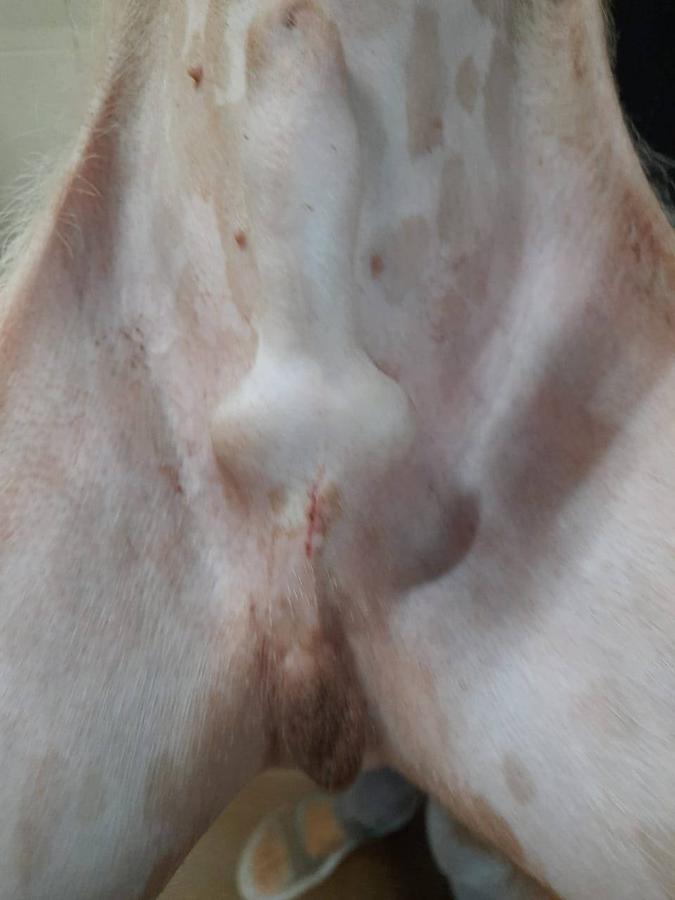
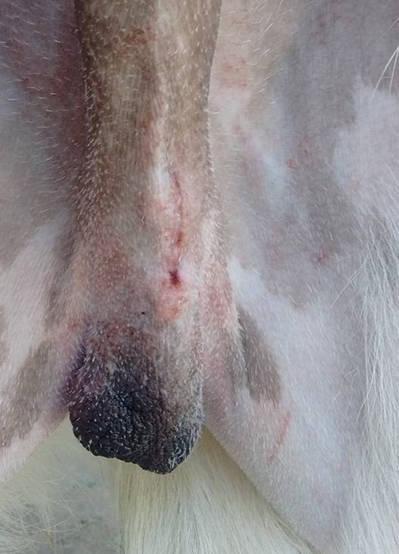
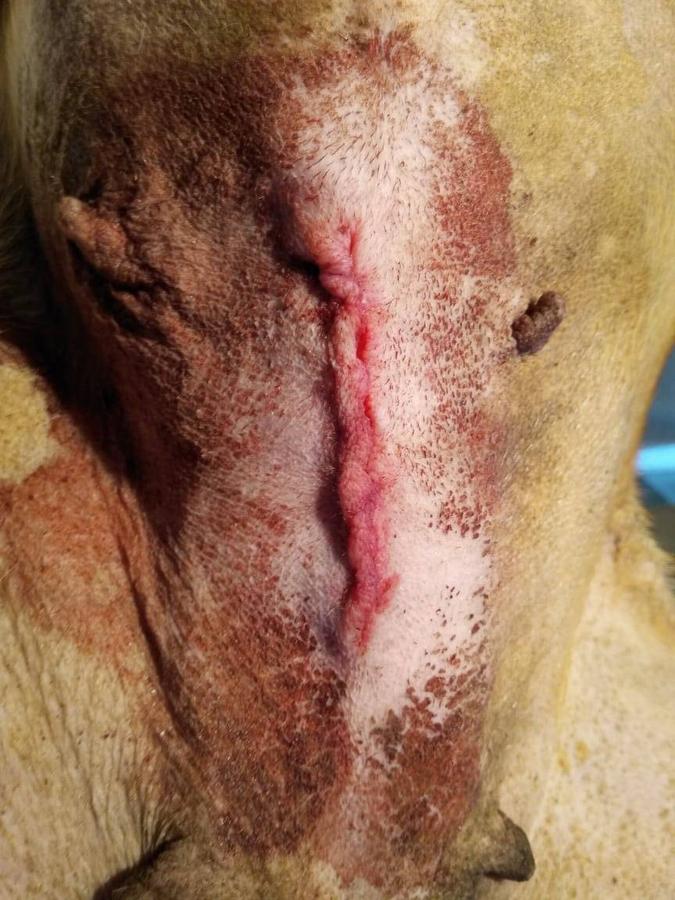
Wound scoring should be carried out every morning by a veterinarian and the scores recorded on the patient's record sheet. Wound scoring and pain scoring should be performed together.
Common reasons for high wound scores
Below show the most common reasons for observing wound scores of either 2 or above:
Inflammation of the skin near to but not in surgical site. This is likely due to grasping of the skin too tightly with instruments such as rat tooth forceps.
Gaping of the wound. Due to inadequate tightening of the intradermal sutures, or poor technique for taking bites through the incision site from beginning to the end.
Discharge from the wound. A break in asepsis leading to introduction of infection.
Bleeding from wound. Poor ligation technique resulting in diffuse bleeding from subcutaneous tissues.
Knot not buried properly. This is due to the incorrect placement of the needle when taking bites through the tissue towards the end of the incision. To ensure that the knot is buried, deep in-out and out–in bites are required at this location.
Raised suture site or puckering of skin. This occurs when bites are not taken close enough to the skin or are not of equal thickness from both edges of the wound.
Wound dehiscence. If bites of the subcutaneous or intradermal tissues are less than 2 mm thickness, this can result in dehiscence. Ideally, they should be 2-3 mm thick.
Inflammation of scrotum (males). This can occur if the incision is extended too far caudally up to the margin of the scrotum.
Pain scoring
At the same time as wound scoring, the patient is assessed for pain. This is based on the visual appearance of the dog and its reaction to gentle touch around the surgical wound, scored with a pain scale from 0 'no pain', to 9 'excruciating pain'1.
| Pain level | Clinical signs often associated with degree of pain |
|---|---|
| 0 No pain | Bright, eating, sleeping comfortably, grooming, affectionate |
| 1 Mild discomfort | Eats, sleeps, resists surgical palpation, not depressed |
| 2 Mild pain | Picks at food, guards surgical area, slightly depressed |
| 3 Mild to moderate | Inappetant, guards/looks/licks/chews surgical area, unrelaxed, wimpers |
| 4 Moderate | Depressed, reluctant to move, aggressive, may vocalise, mydriasis |
| 5 Increased moderate | As 4, but more pronounced |
| 6 Moderate to severe | Very depressed, will not move even to urinate, vocalises often |
| 7 Severe | Motionless, extremely depressed, vocalises |
| 8 Increased severe | As 7, hyperalgesic wherever touched, trembling, will die from pain |
| 9 Excruciating | Piercing screams, nearly comatose, patient will die from pain |
Table 1 - Subjective scoring system for post-operative assessment of pain in dogs that have undergone spay-neuter surgery.
Scores of 0 are ideal; score 1 may be observed occasionally. You should rarely see a score of greater than this. Only animals with a score of 0 or 1 are considered suitable for release/discharge.
These scoring systems were used in a study carried out at our training centre in Ooty, Tamil Nadu, India, to demonstrate that high-volume, low-resource sterilisation of dogs can be performed with a low incidence of surgical complications and low mortality (Airikkala-Otter et al., 2018)2.