
Delivery of any mass vaccination programme depends on a well-organised, motivated workforce, who are aligned in the mission and approach of the campaign. It is the cumulative action of hundreds, if not thousands of people’s daily efforts in the field that result in the successful distribution of vaccine to a population. Every team needs a clear structure to ensure that decisions and expectations are clearly disseminated throughout the team and feedback and challenges from the field are communicated back to the leadership.
The specific structure of each team will depend on the size of the campaign and organisations involved, however the following outlines suggested broad structures for campaigns of different sizes.
Campaign Lead & Campaign Hub
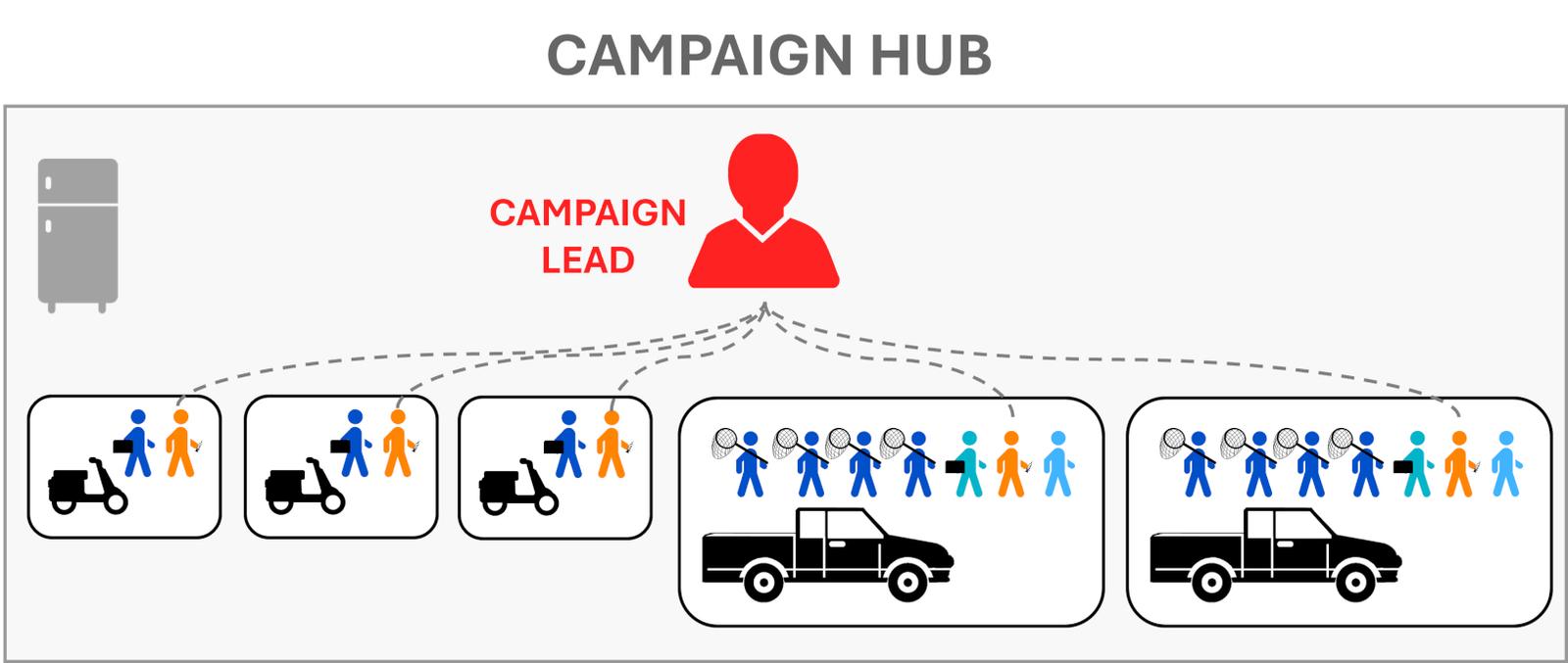
Every Campaign must have a Campaign Lead, who is responsible for the overall execution of the campaign. It is the their duty to oversee the wellbeing of the team and the standards of the programme. On small campaigns, for example with less than ten vaccination teams, the Campaign Lead may directly administrate and manage all of the teams, primarily coordinating with the Team Leads (Figure 2).
Coordination. In this scenario the campaign will typically operate out of a single core location, where vaccines and equipment are securely stored and the campaign is administrated. We call this the Campaign Hub. All vaccination teams will typically meet at the Campaign Hub at the start of each day to register attendance, organize the workforce and stock up with supplies before deploying to the field. Similarly teams will return to the Hub at the end of every day to return unused vaccine and prepare equipment for then next day.
Campaign structures become more complex as the number of vaccination teams increases.
Vaccination teams
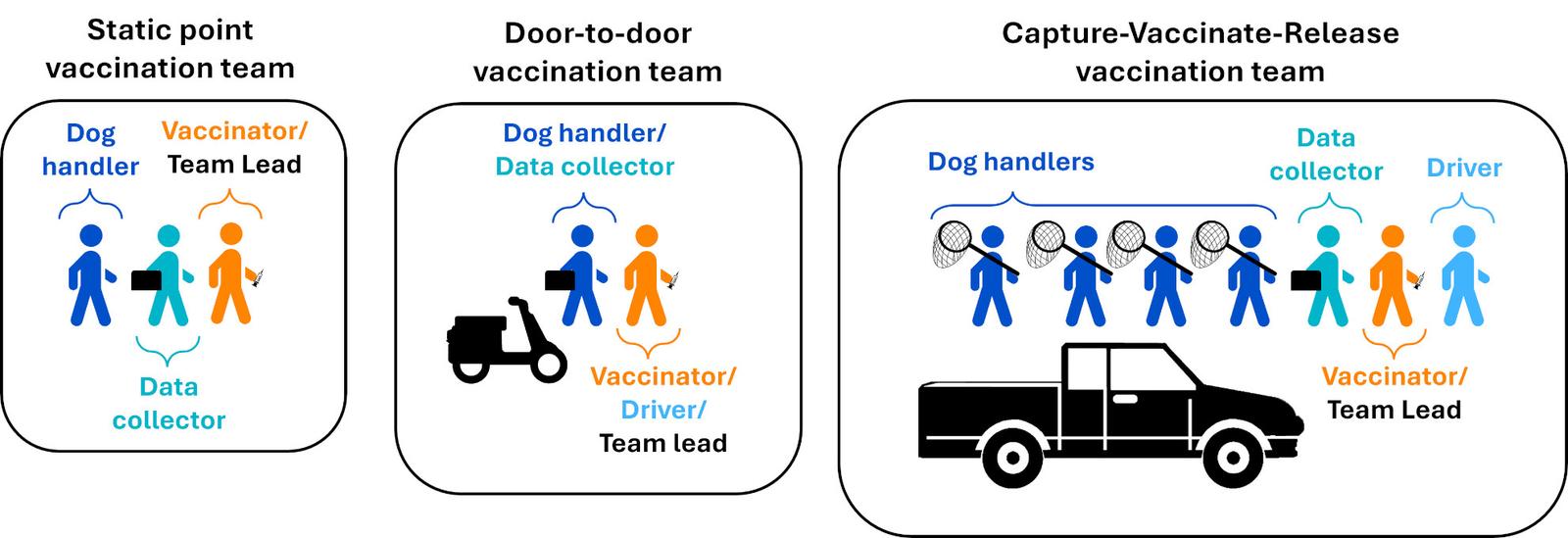
The smallest management unit of any campaign is the vaccination team - this is the smallest group of people that can deliver vaccine to dogs. The composition of each team will depend on the specific vaccination approach and will vary from a single person in some situations, to teams of six or more people (Figure 1).
Roles. It is important that the roles within the vaccination team are clearly defined so that each person knows what they are responsible for. Potential roles can include the following, with individuals often occupying multiple roles at the same time:
- - Vaccinator - the person responsible for administering vaccine
- - Data collector - responsible for keeping records of the dogs vaccinated and giving vaccine certificates
- - Driver - responsible for driving the transport vehicle for the team
- - Dog handler - responsible for restraining dogs for vaccination
Team Lead. It is also important that every team has an assigned Team Lead - this is the person who is responsible for the actions of the team and must take the lead on decision making or resolving issues. The Team Lead may have any role in the team and should be the most responsible individual.
Squads / Vaccination Team Groups
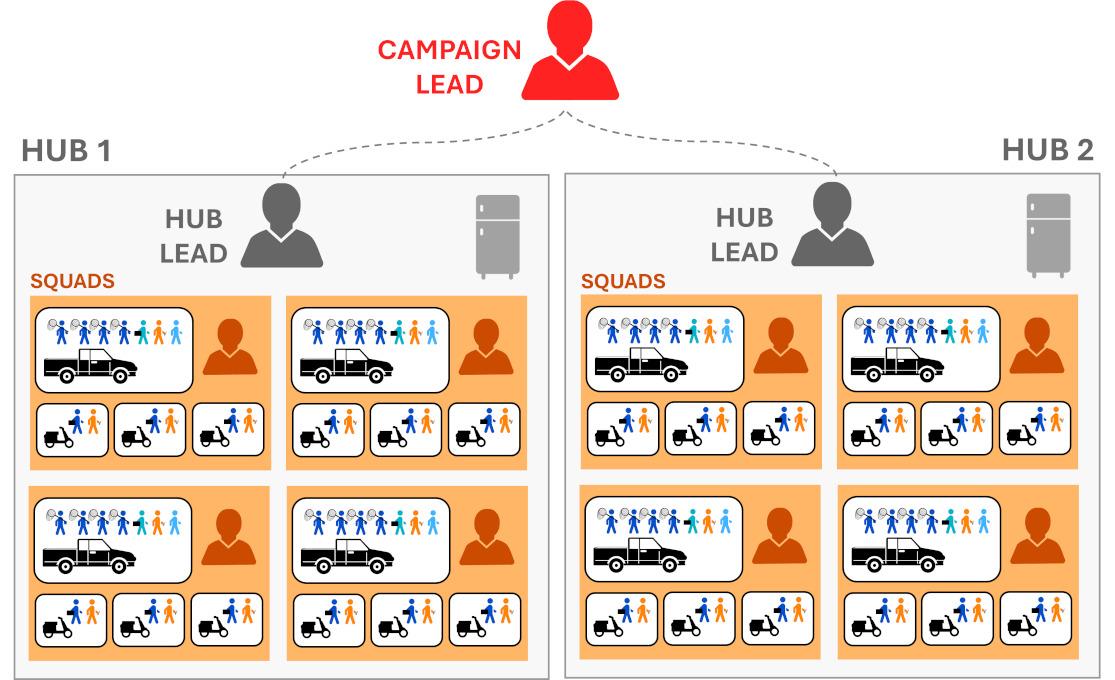
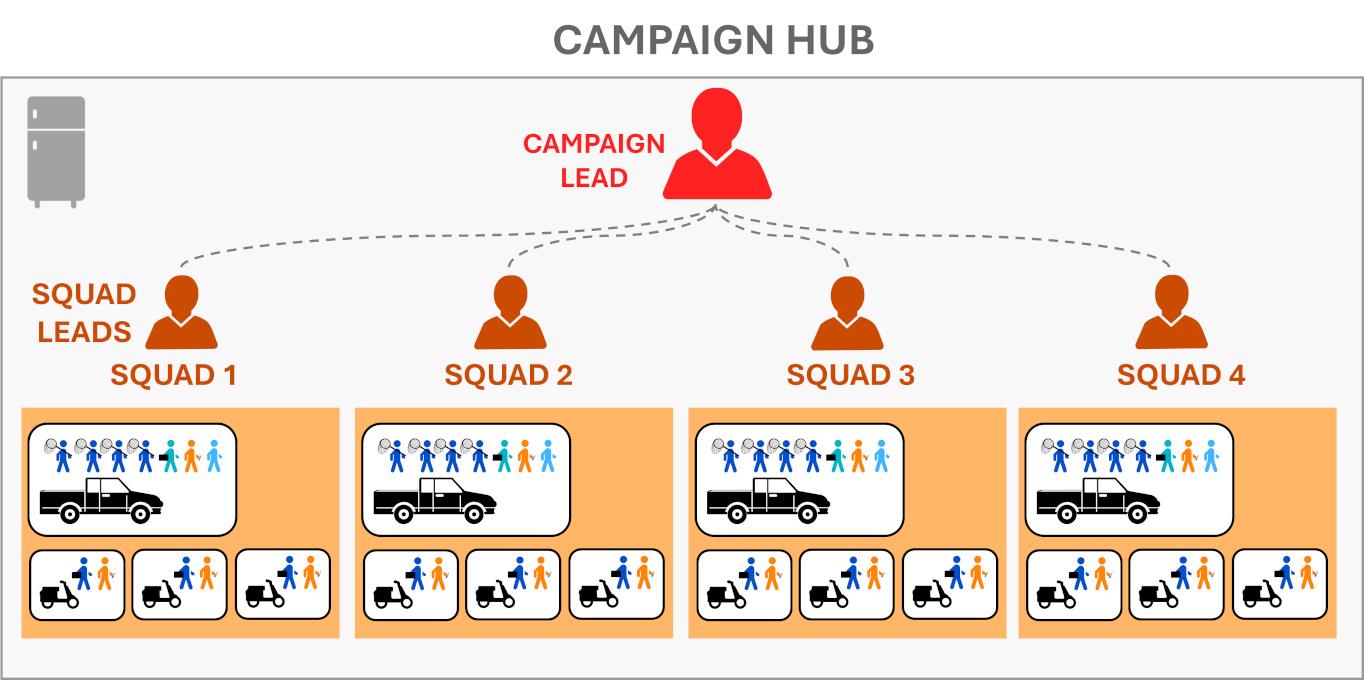
Once the number of vaccination teams operating out of a single location increases above eight to ten, the number of people and equipment becomes difficult to centrally coordinate and it is necessary to group vaccination teams that can then be assigned a Lead who administrates the group. The term for these vaccination team groups varies, however for the purposes of this resource we will call them Squads. The grouping of vaccination teams into Squads, each given a name, can also foster a sense of comradery and positive competitiveness between Squads.
Squad Leads. Each Squad is assigned a Squad Lead who is responsible for managing that group of vaccination teams. They will typically work directly with the Team Leads of their group to monitor attendance of the staff within teams, ensure that teams arrive and depart for vaccination sessions on-time, and resolve general issues such as restocking and coordinating PEP compliance.
Communication. In a campaign of this size, Squad Leads report directly to the Campaign Lead to create a clear chain of command. Insights and issues encountered by vaccination teams on the ground are communicated through the Team Leads to the Squad Leads, who in turn brief the Campaign Lead. This ensures that the strategy can be adapted as the campaign unfolds and that changes in approach can be effectively communicated to the entire workforce.
Hubs
As campaigns grow even larger, the area to be simultaneously vaccinated also increases. This can mean that it becomes logistically infeasible to manage the entire campaign workforce from a single location. Either the distances that teams must travel each day to reach their vaccination areas becomes too large, or the physical space required to accommodate all vaccination teams and their equipment is not available. At this stage the campaign must be managed through numerous distinct Hubs, each servicing a specific administrative region, such as a zone of a city or district (Figure 4).
Hub Leads. Each Hub is administrated by a Hub Lead who is responsible for the running of operations at the hub, maintaining stock and attendance etc. The Squad Leads report to the Hub Leads, who report directly to the Campaign Lead.
Scaling. The campaign structure continues to scale in this way, with multiple Hubs then reporting to Project Managers who report to the Campaign Lead. Even where campaigns are implemented through Government, it is necessary to assign leadership roles to specific individuals for delivering the campaign. These people may be recruited specifically into these positions or be seconded from existing government roles for a period.