

Type of Vaccine
There are many different rabies vaccines on the market; if procuring from a vaccine bank, the project may not have a choice in which vaccine is used. However, if a choice is available, the following considerations should be made:
- Thermostability - How temperature stable the vaccine is – some produced are able to be kept at a wider temperature range
- Vial size - The size of the vials (1ml or 10ml are the usual options) – for reduced wastage and storage requirements, 10ml are more efficient
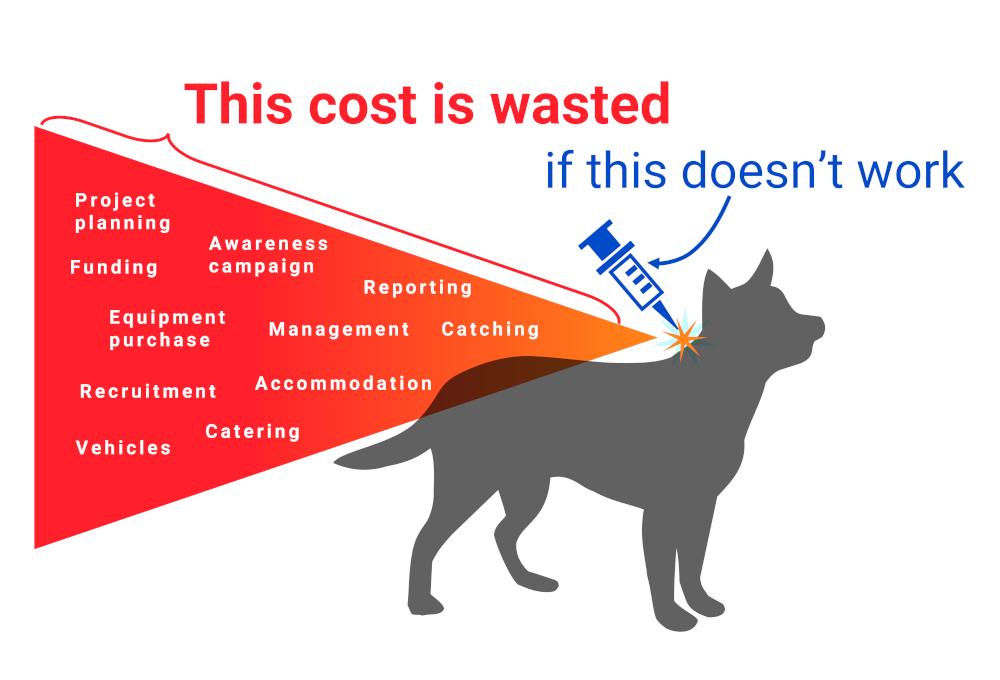
- Price - The cost of parenteral vaccine generally constitutes a small proportion of total campaign cost (10 - 20%), with the majority of expense coming in human resource, transport and equipment. Therefore compromising for a cheaper vaccine to save a small proportional cost risks undermining the impact of the whole campaign if the vaccine does not initiative immunity in vaccinated dogs (Figure 1).
How many Vaccines?
This should be considered over 6 months prior to the planned dates of the vaccination campaign as the process can take some time. If the project has a fixed vaccination area, dog population estimates will be vital to determine how many vaccines to procure. There are several tools available to calculate this including VaxPlan and GDREP.
📚 Please see the United Against Rabies toolbox article for information on VaxPlan and GDREP
According to the WHO, achieving 70% vaccination coverage is sufficient to produce herd immunity against rabies even in an unstable dog population. Therefore, once a dog population estimate is established, calculating 70% of this is advisable as the absolute minimum number of vaccines required.
Wastage
To allow for wastage, the imported vaccine number should be 5- 20% higher than the goal of delivered vaccines. For example, a project aiming to deliver 10,000 vaccines should procure 11,000 vaccines to ensure 10,000 can still be administered accounting for wastage.
Means by which vaccine can be wasted include:
- Incorrect storage; excessive access to UV light or freezing
- Incorrect delivery; injecting when the needle is too loose on the syringe, or the needle is all the way through the skin.
- Accidental loss or damage; the vial is dropped, or the filled syringe is dropped
- Spillage while drawing up into the syringe; this can be due to a build up of pressure in the bottle during transport, or accidental injection of air into the vial
All the above can be mitigated through pre-project training and careful execution of campaign SOPs.
WOAH Rabies Vaccine Bank
The World Organisation for Animal Health has successfully set up regional vaccine banks for Avian Influenza (AI), Foot and Mouth Disease (FMD), Peste des Petits Ruminants (PPR) and Rabies Virus (RABV) since 2006, with funding from all over the world. Since 2014, the WHO only procure their rabies vaccines through the WOAH bank and WOAH has supplied them with 16.3 million doses of vaccine. The rabies banks enable the procurement of high quality vaccines manufactured in line with intergovernmental standards; they also reduce the amount of red tape involved in the procedure and are set-up to accept various funding mechanisms.
The WOAH vaccine bank can be accessed by:
- Contacting the corresponding WOAH regional office to arrange procurement
- Identifying source(s) of funding for the vaccines before submitting an official request
- Completing the Justification Form, presenting the case for the campaign
- Selecting the manufacturer you want to engage with and provide details about the quest, i.e. quantity, vial size, delivery dates etc
- Submit an official letter from a WOAH delegate or the Minister to the WOAH Director General