

Overview
Also called granular dermatitis or 'summer sores'. This is a proliferative (meaning rapidly growing above the skin surface) and localised inflammatory skin condition caused by cutaneous fly infestation. Fly activity is seasonal as it depends on temperature ranges suitable for adult survival and moisture levels suitable for larval development.
Clinical signs
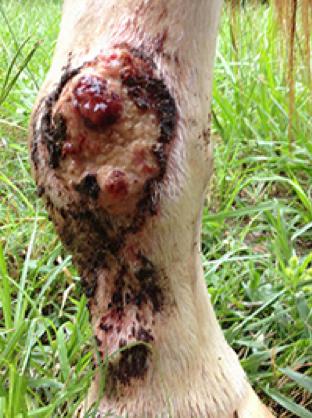
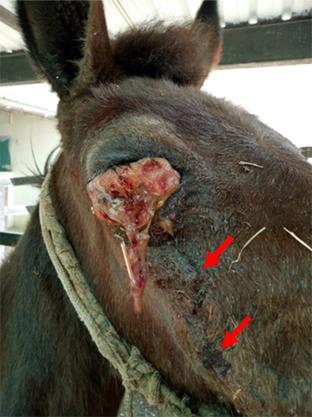
The disease can attack any cutaneous area where there is a lesion already present, although areas commonly affected are the periocular region and moist areas that may attract flies such as the prepuce and lips. Initial findings are a non-painful, non-healing lesion, with serous clear discharge, which can initially be quite pruritic (itchy). As the horse rubs and further irritates the area, these can change to become painful, proliferative lesions with chronic superficial skin breaks and secondary infections.
Periocular lesions are especially concerning, as the localised swelling and rubbing of the face can cause damage and prevent the the eyelids from closing. This results in direct or secondary trauma to the eye bulb (ranging from simple conjunctivitis to corneal ulcerations).
Diagnosis
A diagnosis is usually made based on clinical findings of ‘greasy’, serosanguineous (blood and serum) non-healing ulcerative lesions, in the presence of flies. When cut into, these lesions contain yellow, calcified ‘rice/grain-like’ material with extensive epidermal erosion and focal ulceration with necrosis of the underlying dermis.
Cutaneous lesions can be biopsied and examined under a microscope, where the dermis often appears rich in eosinophils, epithelioid cells and scattered necrotic debris with neutrophils.
Treatment
Depending on the severity and stage of the disease, a number of approaches may be needed. These frequently include a mixture of medical and surgical treatments, often repeated until the skin lesions have fully healed and there is no sign of recurrence.
Systemic deworming products
Deworming is necessary in order to kill the larvae embedded in the tissues. Effective drugs include ivermectin or moxidectin.
While oral pastes are available and administered based on a predefined body weight scale (presented on the dosing syringe), alternative formulations can be used at the following doses:
- Ivermectin. 0.2mg/kg PO every 6-8 weeks
- Moxidectin. 0.4-0.5mg/kg PO every 8-12 weeks
Topical ointments
Topical Dimethyl Sulfoxide (DMSO) and glucocorticoid creams can help reduce itchiness and pain, as well as reduce swelling. This can be extremely useful in sensitive areas such as the inguinal and periocular regions.
⚠️ When treating periocular skin, do not to allow any ointments to come into direct contact with the eye itself
Topical ointments are also useful before surgery to reduce the size of the mass and minimise the likelihood of surgical risks and complications.
Surgical removal
Removal. When present, granulomatous lesions must be completely removed by sharp excision using a scalpel blade, to ensure the larvae are exposed to treatment and also removed from the tissues. Fly eggs will create a gritty effect when the lesion is cut, and these must all be completely removed.
Parasiticide drug. The area then benefits from local infiltration with a 50:50 mixture of ivermectin (or moxidectin) mixed with dexamethasone to kill any remaining infection and reduce the inflammation.
Healing. Wounds are left to heal by second intention, but must be protected from subsequent 'fly strike' (damage caused by invasion of flies) using a fly cover or suturing a bandage.
Antibiotic and anti-inflammatory medication
Oral or systemic antibiotics and non-steroidal anti-inflammatory drugs (NSAIDs) can help reduce the pain after surgery has been completed.
Common antibiotic drugs used include:
- Trimethoprim-sulfonamide at 15-30mg/kg PO or IV twice daily.
- Oxytetracycline at 5-10mg/kg IV once daily.
Common NSAIDs used include:
- Aspirin at 5-20mg/kg PO or per rectum once daily.
- Phenylbutazone at 2.2-4.4mg/kg IV once or twice daily.
- Flunixin meglumine at 0.5-1mg/kg IV or IM once or twice daily.
Prevention
Topical fly repellent
These can be in the form of sprays or dips containing natural (i.e. citronella based) or synthetic (cypermethrin, permethrin and pyrethrin). Their effect is short-lived, especially in hot/humid areas where animals may sweat. Beware of causing skin sensitivity in animals exposed to direct sunlight in extreme heat or if the concentration of active ingredients is high. Skin reactions may include itchiness, rash and hair discoloration or hair loss at the application site. If these are noted, wash the animal with plenty of clean fresh water and do not use further sprays.
Sanitation
💡 By far the most important way of preventing the disease is to reduce the number of flies or their access to vulnerable body regions
This can be achieved by burning or burying household litter and removing and disposing of faeces and other paddock litter, so that the number of flies are reduced in animal resting areas.
Fly rugs and fly masks
These can be made from simple cotton material or synthetic fly netting. Their purpose is to prevent flies from directly contacting the skin of the horse and depositing their eggs. While custom made rugs and masks are available, these can also be hand made. It is not possible to fully cover a horse's body, but it is most important to cover open fresh wounds, especially during early granulation stages.