

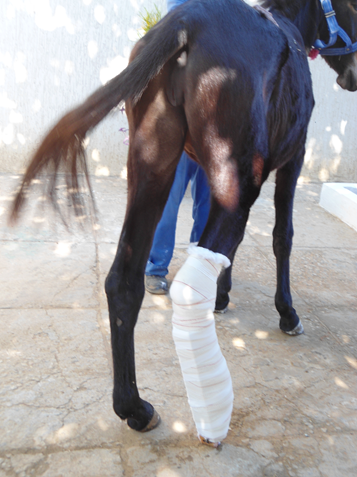
Fractures in horses can often be career ending and life threatening. The primary goal when attending a potentially fractured patient is to ensure pain relief. This can be achieved with appropriate drug administration and by stabilising the fracture.
Ensure you have the following kit in your vehicle prior to attending a potential fracture case:
- Sedation and pain relief
- Clippers to check there are no puncture wounds from the fragmented bones
- Cotton wool, gauze and disinfectant to clean the leg
- Bandaging material
- Splints (custom made or home-made from gutter tubing split in half) and/or cast material
- Elastic and duct tape
- Ropes to support the limb as you move the animal
- Euthanasia kit
Fractures can give differing degrees of lameness. Complete and severe fractures are often associated with non-weight bearing lameness, while incomplete or stress fractures can often only cause low level, chronic lameness. Diagnostic imaging techniques are necessary to confirm a fracture diagnosis, and while this may not be possible in the field, nerve blocks and extensive work-ups should be avoided until a fracture is excluded.
Hoof abscesses and cellulitis cases also present with non-weight bearing lameness, and should be excluded
Case selection
In cases of confirmed fracture, there are some considerations to be taken in selecting cases for fracture repair.
The decision on whether to attempt treatment or not, and what treatment to opt for, is based on:
- Type and location of the fracture;
- Configuration (greenstick or fissure / transverse / oblique / spiral / comminuted / avulsion);
- Location (on the body and on the bone: diaphyseal, metaphyseal, physeal);
- Degree of secondary soft tissue and vascular damage;
- Age, weight and nature of the horse (cooperative or not);
- Length of time since injury;
- Economic constraints and realistic outcome for possibility to return to function.