

Key points
Injection of intra-testicular and subcutaneous lidocaine prior to routine castration in dogs provides additional analgesia to the patient in the peri-operative period as well as anaesthesia-sparing effects making the surgical procedure lower risk. The technique is simple and inexpensive, using lidocaine, which is widely available and safe to the patient. Here we review the evidence behind this simple technique which should be added to standard protocols for performing routine dog castration in high-throughput settings.
Background
Surgical castration of male dogs is a common procedure in veterinary practice. It is carried out under general anaesthesia, with analgesia provided using a combination of systemically administered drugs. The preferred technique is to use a balanced anaesthetic combining several different classes of drugs, usually an injectable and/or inhalational anaesthetic together with an opioid. This reduces the doses of each individual drug necessary (Tonner 2005). Regional anaesthesia techniques are widely used in other surgical procedures (Duke 2000a,b), however are frequently overlooked in routine spay-neuter surgeries as an area where analgesia can provide benefits to the patient in the perioperative period.
Studies
Local anaesthetics have long been employed as part of multimodal protocols to enhance pain relief. They act by interrupting the ascending pain pathway by blocking sodium channels in nerves. Also, they are relatively inexpensive, easy to use and can be given before or after a surgical procedure. However, the use of local anaesthetics can carry some risk and concerns have arisen regarding systemic absorption and potential cardiac side effects (Stevens et. al. 2013).
A study comparing dogs that only received general anaesthesia and those that received general and local anaesthesia showed that the nociceptive response to surgery (measured by pulse rate and mean arterial pressure) was alleviated by the use of intra-testicular and subcutaneous lidocaine (Moldal et. al. 2013).
Huuskonen et. al., 2013 investigated whether intra-testicular injection of lidocaine pre-surgery would reduce the intraoperative responses to elective castration in dogs. In a comparison study where half the dogs received intra-testicular saline (group S) and the other half received intra-testicular lidocaine (group L), the dogs in group L had significantly lower maximum values for both HR and MAP.
Application
Here we describe the use of this technique in the clinical setting.
- Dogs are premedicated using an appropriate combination (e.g. xylazine (2mg/kg) and butorphanol (0.2mg/kg))
- Following sedation, IV access is gained by catheterizing the cephalic vein and anaesthesia is induced using a diazepam – propofol combination (0.25mg/kg and 1 mg/kg respectively) IV.
- Multimodal pre-emptive analgesia is provided using meloxicam 0.2mg/kg IV, tramadol 4mg/kg IV and lidocaine 1mg/kg IV bolus.
- The surgical site is then prepared through shaving and scrubbing. Following this the sub-cutaneous and intra-testicular lidocaine is administered as detailed below.
Step 1 - Lidocaine is administered at the dose rate of 1mg/kg. The total volume of the drug required is calculated and drawn up in a 3ml syringe.

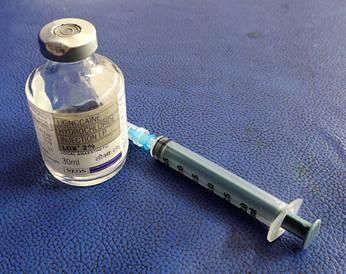
Step 2 - The volume is then made up to 1.5ml using sterile water.
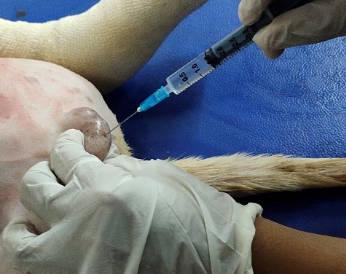
Step 3 - 0.5 ml of this solution is then injected into each testicle using a 24G needle.


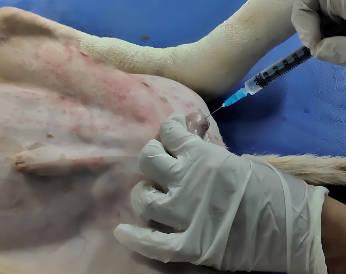
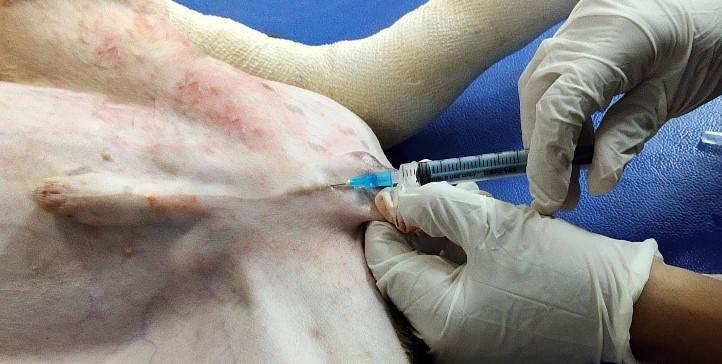
Step 4 - The remaining 0.5ml is injected subcutaneously at the pre-scrotal incision site.

Conclusion
Intra-testicular and subcutaneous administration of lidocaine is an inexpensive and effective method to enhance multi-modal analgesia, reduce the peri-operative pain and thus reduce post-operative complications in male dogs due to self-mutilation of the surgical site.