

In order to achieve a smooth induction for the patient without complications, having good organisational skills is important. Before you start, consider the following:
Is the patient ready? The patient should already have been adequately premedicated and had sufficient time for the drugs to take effect.
Are you ready? All pieces of equipment and drugs required should have been prepared in advance and are now ready to be used. Think ahead!
Is the environment suitable? In order to reduce stress for the patient and prevent high circulating catecholamine levels, environmental noise and number of personnel should be kept to a minimum within the prep room.
IV catheter placement
An intravenous catheter should have already been placed into a peripheral vein to secure access for routine drug and fluid administration, and also for emergency IV access, if required.
Preoxygenation
The administration of 100% oxygen before induction increases oxygen stores in the body and reduces the chances of hypoxaemia occurring. Preoxygenation may not be available in a resource-limited setting. If it is an option, it can be useful, particularly for a compromised patient such as a brachycephalic breed. It can easily be accomplished by holding the end of the breathing system near the patient's nose or mouth. Be aware that some animals will not tolerate this, and the resulting struggling that occurs increases oxygen demand, out-weighing any potential benefits.
Induction
Induction of anaesthesia is achieved through the delivery of your chosen anaesthetic agent. In the previous section, we discussed the use of common intravenous approaches.
Whilst the induction agent is being administered, the veterinarian must assess the respiratory and pulse rate by palpation.
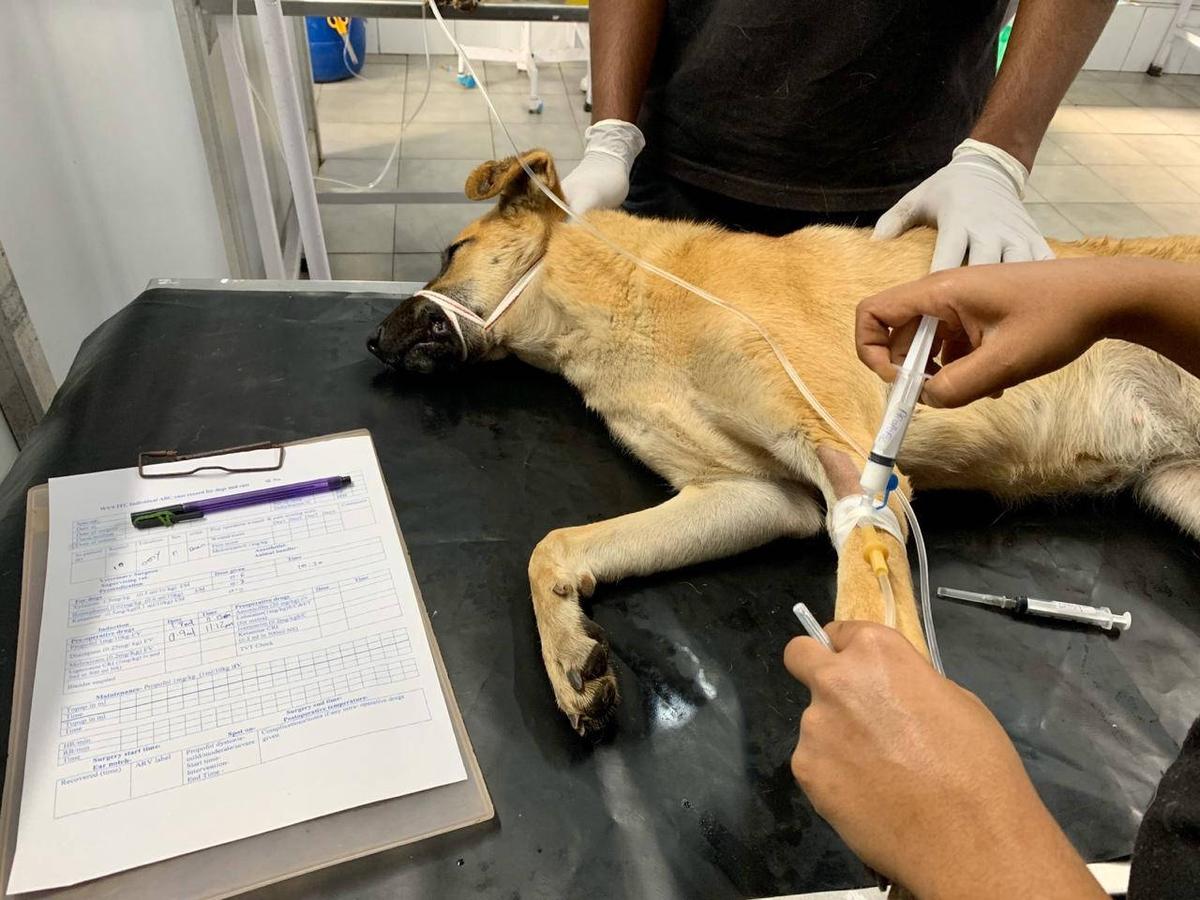
Other medications
As well as the main induction agent, additional drugs will be given at this stage. For our protocols, we use the following:
Analgesia. Meloxicam (0.2mg/kg i.v.) non-steroidal anti-inflammatory drug forms part of a multi-modal analgesia protocol. This is used alongside the other classes of analgesics used in the protocol (e.g. NMDA receptor antagonist such as ketamine, opioid, alpha-2 agonist).
Antibiotic. Amoxicillin (20mg/kg i.v.). Refer to the section on 'Responsible Use of Antibiotics'.
Anti-parasiticide. Ivermectin (0.1ml/5kg s.c. for the treatment of internal and external parasites. (Do not administer to Collies or related breeds).
Regional anaesthesia. Intra-testicular lidocaine in male dogs.
Intravenous fluids. The administration of fluids to maintain hydration and compensate for fluid losses during surgery.
Other considerations
Check and empty the urinary bladder, if required.
In addition, as the patient is unable to blink during anaesthesia, the corneas should be lubricated using tear replacer fluid; this must be repeated at regular intervals until recovery in order to prevent the corneal surface from drying and being damaged.
The patient can now be prepared for surgery