

What is anaesthesia?
Anaesthesia refers to a 'lack of sensation' that results in an animal (or person) not experiencing sensations or feelings.
Anaesthesia can be 'general' which results in an overall state of unconsciousness due to a reversible suppression on the central nervous system (including the brain), or 'local', where only a specific part of the body is affected, leading to loss of sensation (pain, touch etc) in that area.
General anaesthesia
To achieve the state of general anaesthesia where the patient is unable to feel pain or other stimuli, three criteria must be met. This is referred to as the 'triad of general anaesthesia' (Figure 1).
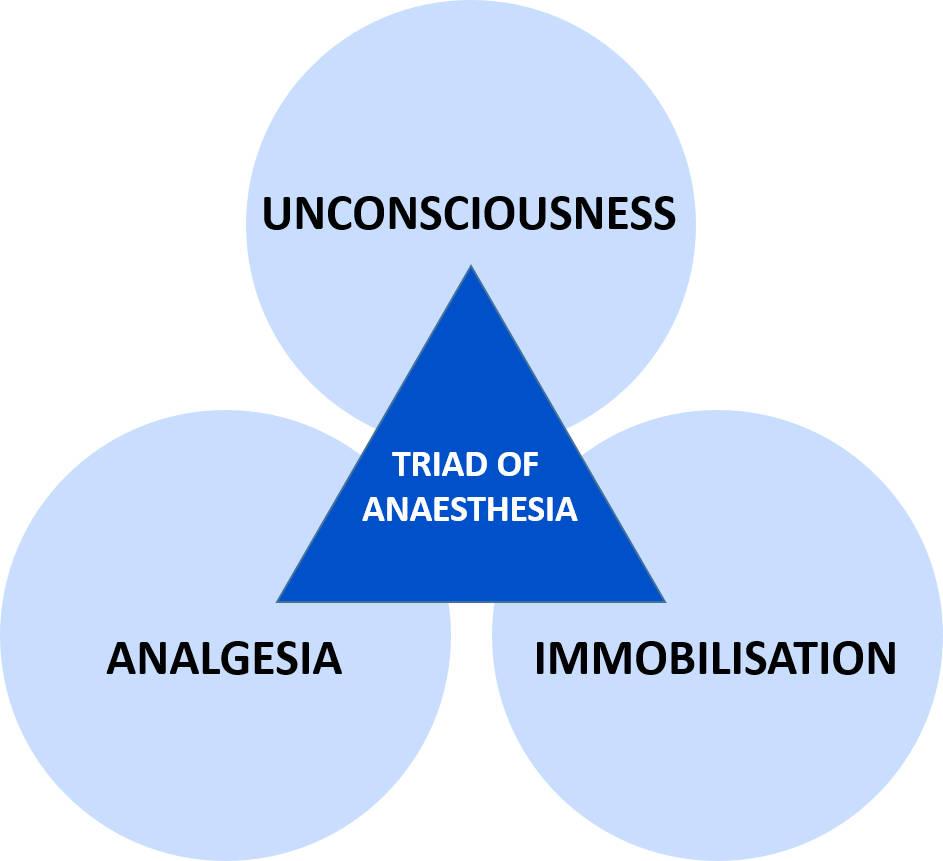
Analgesia (loss of pain sensation). Analgesia involves the suppression of responses to painful sensory inputs (also referred to as anti-nociception). Planning the correct amount and type of analgesia is critically important. Even when the animal is unconscious and is not experiencing pain sensation, the ascending pain pathways can be stimulated leading to up-regulation of nociceptors (pain receptors). This results in an increase in pain experienced by the patient after recovery from anaesthesia. This "sensitisation" process can be prevented by ensuring a balanced protocol of analgesia is provided.
Unconsciousness (narcosis). This is the safe, controlled, reversible depression of the central nervous system, resulting in a lack of conscious awareness.
Muscle relaxation or immobilisation. Muscle relaxation is required to facilitate laryngeal intubation and provide optimal operating conditions.
To ensure that all three components are included, a 'balanced anaesthesia' protocol required.
Balanced anaesthesia
A 'perfect' anaesthetic agent would provide the ideal proportion of these three properties described above for each individual, however, it is important to remember that the 'perfect' anaesthetic agent does not exist. A combination of different drugs must be used, each contributing to the triad of anaesthesia in varying proportions. It is the process of using multiple anaesthetic drugs that is referred to as balanced anaesthesia.
In a balanced anaesthetic protocol, agents will be administered at varying stages; Premedication with a sedative and analgesic drug (this has been discussed in the previous section) Induction with an intravenous drug Maintenance with an intravenous drug (or inhalational agent, if available) Other analgesic drugs such as an NSAID, opioid or NDMA receptor antagonist, or local analgesic techniques
As we have already seen with premedication protocols, the benefit of using a combination of drugs is that the dose for each individual agent can be reduced (synergism). Many side effects are dose-dependent, and therefore lowering the dose will reduce these side effects; these are often significant, such as respiratory and cardiovascular depression.
Side effects
All drugs have side effects! Be aware of what they are and how they can affect the patient. The type of side effects will depend on the anaesthetic drugs/protocol chosen; general effects are summarised below (and will also be discussed for each individual drug):
Central Nervous System. Depression of central reflexes leading to hypotension, hypoventilation, hypothermia and reduced muscle tone.
Cardiovascular System. Depression of on autonomic reflexes (e.g. baroreflex), reduced vasomotor tone, and reduced myocardial contractility, can all result in hypotension.
Respiratory System. Depression of autonomic reflexes (e.g. changes to levels of pCO2, pO2, and blood pH), alveolar compression, decreased muscular activity can all result in hypoventilation, hypercapnia and hypoxaemia.
Patient monitoring is therefore critical in ensuring that tissue perfusion is maintained by the delivery of adequate levels of oxygen, and that carbon dioxide is removed.
Depth of anaesthesia
The depth of anaesthesia has often been described in terms of 'planes' or 'levels' of anaesthesia, which were originally defined using the anaesthetic gas ether, as the sole agent. With modern, balanced protocols, combining multiple drugs with differing effects on the patient's responses, these levels are now less relevant; however, it is still useful to consider the concept of anaesthetic depth.
The following table has been included for interest and as a general guide:
Stage I: Voluntary excitement. Between induction and unconsciousness Stage II: Involuntary excitement. Between unconsciousness and rhythmic breathing. The jaw is tense, Pedal and palpebral reflexes are strong; pupil is central and constricted Stage III: Surgical anaesthesia (subdivided into Plane 1, 2 and 3) Plane 1: (Light surgical). Jaw tone is relaxed. Reflexes: pedal absent, palpebral reduced. Pupil ventromedial. Breathing slow and regular; pulse regular and normal. May be appropriate for some minor, relatively painless procedures. Plane 2: (Moderate surgical). Jaw tone is absent. Reflexes: pedal absent, palpebral absent. Pupil ventromedial. Breathing slow and regular; pulse regular and normal. Appropriate for most surgical procedures. Plane 3: (Deep surgical). Jaw tone is absent; eyeball becomes central, Reflexes: pedal absent, palbepral absent. Pupil almost central. Breathing involves a large abdonimal component; pulse rapid and low. Stage IV: Excessive depth of anaesthesia (overdose/coma/near death). Jaw tone is absent; eyeball becomes central. Reflexes: pedal absent, palpebral absent. Pupil almost central and dilated. Breathing-agonal gasps, pulse rapid and shallow. Must be avoided.
Risks
No anaesthetic is risk-free; even in healthy animals, there is always a small risk of mortality. In healthy dogs, one in 1800 will unfortunately die under anaesthesia. For an animal that is particularly old, young, or has a pre-existing health condition, the risk may be increased.
Always remember that there are no safe anaesthetics; only safe anaesthetists!
Legalities and consent forms
In many countries, anaesthetic records are legal documents. In a spay-neuter setting, where the majority of dogs are unowned, free-roaming, then legal matters relating to ownership and consent are not applicable. However, if you are involved in neutering owned dogs, whether they be free-roaming or restricted, you must ensure that you work within the legal requirements of the country you are in.
All anaesthetic documents should be kept as evidence of accountability for each patient. In addition, owner consent must be sought prior to admitting the animal. The risks of the procedure should be carefully explained, with respect to both the anaesthetic and the surgical procedure, and a written consent obtained.
Local anaesthesia
Local anaesthesia removes pain sensation in a specific region of the body. The effect is localised and does not result in loss of consciousness, as is the case with general anaesthesia. Local anaesthetic techniques provide additional analgesia, thereby contributing to the practice of multimodal analgesia (see analgesia section). Local anaesthetic agents also reduce the overall dose of general anaesthetic required.
These techniques will be discussed further in this module.