
The benefits of fluid therapy
It is recommended that all anaesthetised patients receive intravenous fluids when undergoing routing spay-neuter surgery. In addition to maintaining IV access for administration of medication intra-operatively, the purpose of administering IV fluids is to:
Address side effects of anaesthetic agents. This will ensure that the undesirable, physiological effects of anaesthetic agents on the cardiovascular system, such as bradycardia, hypotension and vasodilation, are addressed by supporting the circulation and maintaining blood pressure.
Replace ongoing fluid losses. Maintaining normal fluid balance by correcting fluid losses that occur during anaesthesia and surgery, such as evaporation from the surgical site and blood loss.
For routine spay-neuter surgery, a balanced, isotonic crystalloid fluid, such as lactated Ringer's solution or Hartmann's, is appropriate.
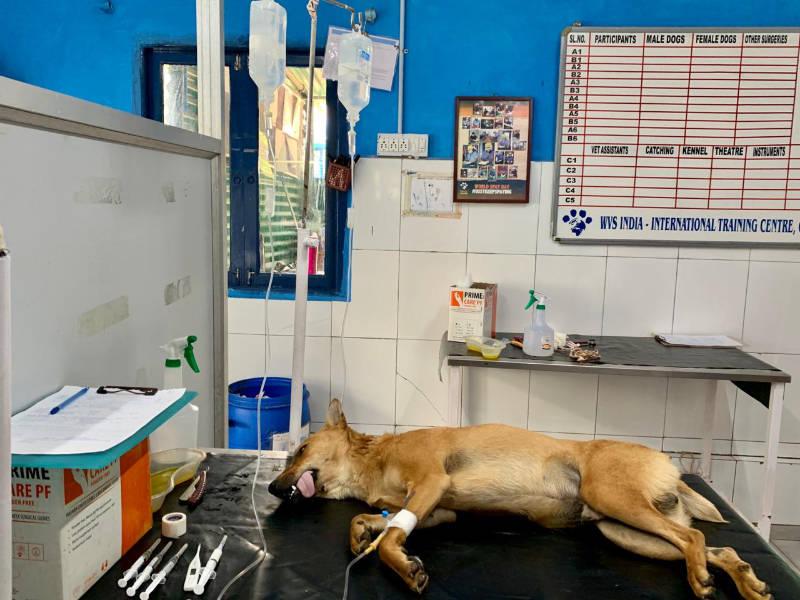
During anaesthesia the patient should be continually assessed, particularly focusing on the cardiovascular parameters, and the fluid rate adjusted as necessary. If anaesthesia lasts for more than one hour with no ongoing losses and the patient is stable, the fluid rate can be reduced by 25% every hour until maintenance rate is reached.
If hypotension occurs, a bolus of crystalloid fluid may be given, providing there are no contra-indications. In dogs, a bolus of 5-10 ml/kg can be given over 5-10 minutes by increasing the drip rate accordingly, or, using a fluid infusion pump, if available. Patient parameters are assessed after the initial bolus administration, which can be repeated once more if necessary.
If too high a fluids rate is given, the following deleterious effects may occur:
- Decreased pulmonary function in the event of pulmonary oedema
- Reduced tissue oxygenation
- Coagulation deficits
- Decreased PCV and TP
- Increased infection rate
- Reduced gut motility
- Reduced body temperature
Further information on maintenance and shock doses of IV fluid therapy are provided in the Quick Reference section
Equipment required
Fluids are delivered through the IV catheter to the patient's venous system via a giving set. The IV canula is generally placed and secured once the animal has been sedated; the giving set that is connected to a fluid bag, is secured to the IV catheter after induction.
There can be a choice of giving sets:
Standard giving sets deliver 20 drops/ml
Paediatric/burette giving sets deliver 60 drops/ml, which can be useful for smaller patients.
Some giving sets are fitted with a dial flow regulator on the tubing, enabling fluid delivery to be set at an amount between 5-250 ml/hr. Infusion devices (volumetric pumps and syringe drivers) are also available but are uncommon in the spay neuter setting.
Calculating fluid rates
The patient should receive 5 ml/kg/hr and weighs 15 kg, therefore requires 5 x 15 = 75 ml/hr
A standard giving set delivers 20 drops/ml
20 drops/ml x 75 ml/hr = 1500 drops/hr
1500/60 = 25 drops/min which is 25/60 = 0.4 drops/second or approximately 1 drop every 2-3 seconds.
For smaller patients, it can be difficult to accurately set the drip rate. Infusion devices are more accurate in their delivery.
💡 In hot countries, free-roaming dogs may have some degree of clinical dehydration. In this instance, these patients may benefit from a slightly higher fluid rate based on their estimated % dehydration status, which is added into the final calculation above. However, remember that dehydration is usually corrected over a 24 hour period and so complete rehydration will not be achieved over the surgical period alone See the Quick Reference Guide on Fluid therapy for further information on calculating fluid requirements for dehydrated patients.
Reference:
2024 AAHA/AAFP 'Fluid Therapy Guidelines for Dogs and Cats. Available at: https://www.aaha.org/resources/2024-aaha-fluid-therapy-guidelines-for-dogs-and-cats/ [Accessed 23rd July 2025]