

Purpose
The REACT application digitizes the concepts of the Integrated Bite Case Management (IBCM) approach for investigation and data recording to strengthen rabies control and simplify surveillance methods. This approach integrates data collection and reporting at the community level, with animal/human government sector programs and field response, in order to most effectively reduce rabies’ burden.
Structure
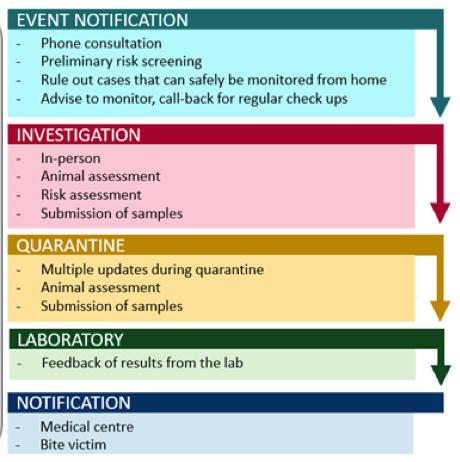
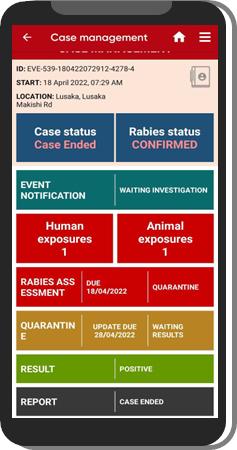
Users enter data on structured forms for each stage of investigation from the event notification to notification of results (figure 1). The app guides the user though each part of the investigation and allows users to schedule follow-up tasks and track case progress.
Once logged on, the user is able to:
- Add a New Case
- Review pending tasks
- Review old closed cases
- Synchronize data to the serve
Event notification

1. Identification of at risk individuals via the Central Rabies Helpline and call screening:
Central Rabies Helpline
A central rabies Helpline serves as a single point of contact with communities, soliciting reports of suspect rabid animals from the public, human health and veterinary sectors.
All calls should be logged in the call log including information about where the call has come from (e.g. village / ward), details of the call, and action taken. A new case can be logged in the app.
Information about each rabies case should be recorded in as much detail as possible at the time of the response in the REACT app.
Screening Rabies Calls
The main objective of the Rabies Helpline operator is to screen calls for the risk of rabies, identify cases considered as possibly rabid, initiate a further investigation in a timely manner, and record the details of calls to support monitoring of rabies surveillance activities.
In cases where rabies is suspected and the dog can not be safely isolated, a member of the response team should be deployed.
💡 Additional training on the Central Rabies Helpline can be found here.
💡 Additional training on Screening Rabies Calls can be found here.
Rabies assesment

2. Attend the event
If the Helpline and call screening stages assess that the situation needs to be assessed in the field, a rabies officer can look up the case details in the REACT app and attend the area to interview bite victims personally and identify appropriate treatment(s) for the animal:
- If the animal appears healthy or has mild symptoms then quarantine for observation and prevention of further transmission is advised.
- If the animal is euthanised due to their symptoms or found dead samples should be sent to the laboratory for testing.
This information can then be added back into the app to progress to the next stage.
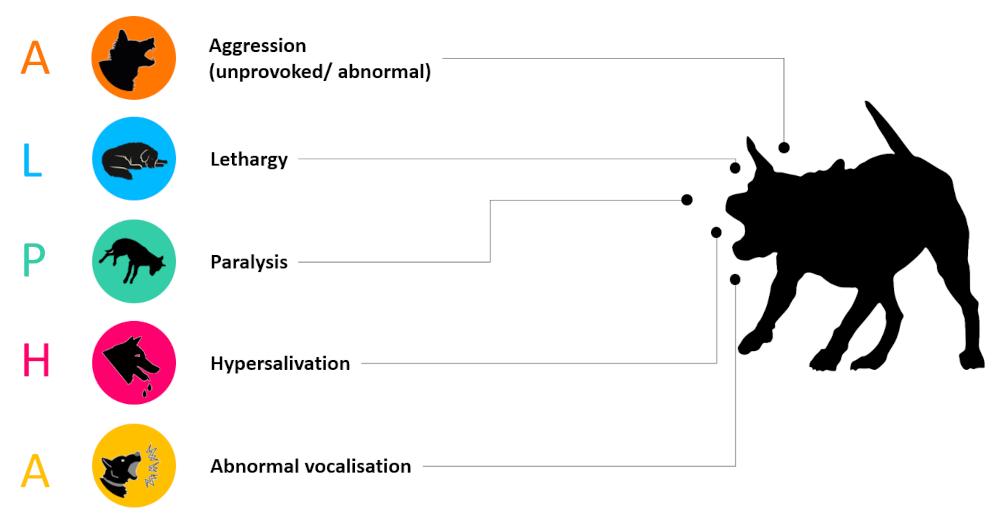
📚 Find further information on rabies symptoms and treatment advice here.
Quarantine updates

3. Quarantine
Dogs in apparently good health, and those exhibiting possible signs of rabies should be quarantined to prevent further bites and possible transmission to other dogs and people.
Death typically occurs within 4 days of symptoms appearing, and is inevitable within 14 days. RABV infection can be ruled out if the animal is still alive after this time. Euthanasia should be considered if there are strong signs of deterioration/ suffering.
Quarantine updates can be logged in the REACT app; a daily schedule can be set up from quarantine day 1.
📚 Further information on quarantine can be found here.
Laboratory results
4. Post Mortem diagnosis
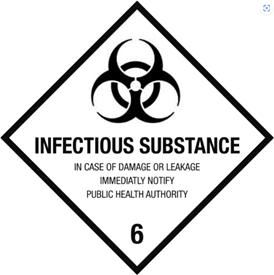
Brain material is required to confirm any rabies diagnosis, and should only be carried out by trained staff. Brain and other nervous material from a suspect rabies case is classified as a Category A Infectious Substance (UN number UN2814) meaning it could cause permanent disability or life-threatening or fatal disease upon exposure to it.
Regardless of whether a RABV is diagnosed rabies or not, this should be updated in the REACT app. Healthcare workers are alerted and can review ongoing treatment for any people or dogs who may have been exposed in this case.
Reporting

5. Report and assess outcome
The Project Administrator can review RABV data from the REACT app where summaries and maps of the data are auto generated. The full dataset can also be downloaded in CSV format for data analysis or reported through systems such as DHIS2 or other national reporting systems. These reports allow for better communication between field workers and decision makers.
💡Additional training on the use of REACT and it's features can be found here.