

The term ‘aggression’ is not a diagnosis, and all animals are capable of using aggression. ‘Aggression’ may refer to a spectrum of canine behaviour, some of which intends to cause physical harm (e.g. biting), whilst some intend to create distance between the aggressor and another dog/human, by using threatening communication signals (e.g. growling).
Most dogs will initially aim to create distance through threatening behaviour, before escalating to physical harm.
There are multiple ways of categorising aggressive behaviour, for instance, by function, motivation, or the context in which the behaviour occurs.
Aggression can be recognised in terms of the facial expressions, body postures, and vocalisations used by the animal:
Behaviours intended to create distance include:
- Growling
- Tense facial/neck muscles
- Baring teeth with mouth open or closed
- Barking (although may be seen in other contexts such as play)
- Straight, stiff tail
Behaviours intended to cause physical harm:
- Bite
- Body wrestle
The Ladder of Aggression
As social animals, most dogs will not immediately exhibit behaviours intended to cause harm. In fact, when presented with a conflict or threatening situation, many dogs will choose appeasing and avoidance behaviours. These are an important part of the dog’s behavioural repertoire to avoid potential harm. Dogs will aim to use these responses first, with the intention of reducing the potential negative outcome of the situation. Only if these fail, is a dog likely to escalate their response to more aggressive behaviours.
'The Ladder of Aggression' was developed to illustrate the range of gestures that dogs may exhibit in response to increasing levels of perceived stress or threat. These gestures vary from subtle signals (e.g. yawning and lip licking), which may be observed during situations of mild stress or pressure, to more severe responses (e.g. growling and snapping) in situations where the stress is high, or threat is imminent (1).
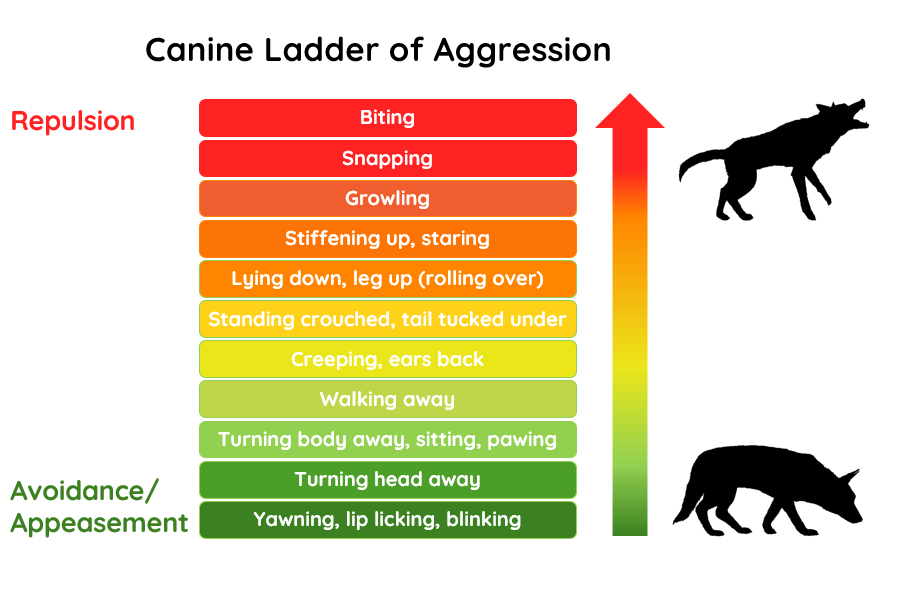
Appeasement aims to reduce the potential negative outcome of a situation/encounter, by actively exchanging information. Behavioural signs involve the complex interchange between:
- Sniffing and licking, which are olfactory appeasement gestures. Often seen during greetings or if there is uncertainty about the individual/interaction.
- Physical contact such as leaning/lying next to, which are tactile appeasement gestures to gain information about muscle tension.
- Lip licking, yawning, looking away, offering a paw, jumping up and rolling over, which are visual gestures. These may be offered slowly or rapidly/intensely.
- A range of vocal communication which may include barking and whining.
Avoidance aims to move the dog away from the perceived threatening situation/encounter. Behavioural signs include actively moving away or hiding, and more passive responses including looking, leaning or cowering away. If a dog is unable to use this response, they may change their response to one with more serious implications.
Inhibition aims to passively gather information about a potential threatening situation/encounter, while inhibiting any active response towards it. Behavioural signs include momentary pauses, which can easily be missed, to prolonged periods of the dog appearing calm and quiet. This is sometimes referred to as the ‘freeze’ response. Inhibition may be chosen if the potential threat/stimulus is overwhelming in intensity or proximity, or the threat/stimulus is unexpected or appears suddenly. Dogs may also learn to inhibit certain responses if they have previously led to a negative outcome.
Repulsion This behavioural response aims to remove the perceived threat by making it move away. Behavioural signs include barking, growling, snapping and biting, with an escalation in intensity if the perceived threat is not removed.
Many behavioural gestures associated with stress and anxiety are also listed here as appeasement and avoidance behaviours. Stress and anxiety may be precursory emotions which may develop into fear-related aggression. It is crucial to be aware of any signs of anxiety so you can anticipate possible aggression (see previous article). However, it’s important to note that not all stressed/ anxious dogs will go on to show aggressive behaviour. The escalation of the response is dependent on many factors (see below).
The sequence of these gestures may be influenced by various factors:
- The context may influence the dog’s ability to use certain behavioural responses (e.g. lip licking may not be possible while muzzled).
- The nature of the threat, e.g. sudden/close versus slow/in the distance. This includes how the veterinarian approaches/handles the dog. If the veterinarian approaches too quickly/closely and the dog feels trapped, this may lead to a sudden escalation in response.
- Previous negative experiences and learning. The dog may have had previous experiences in this environment, for instance, past treatments/examinations. The dog is likely to have learnt which behavioural strategies were most effective in these previous encounters. If aggressive behaviour was most successful in removing the threat/ ending the interaction, they may escalate their behaviour to ‘repulsion’ more rapidly next time.
- Pain, or the anticipation of pain, may lead to increased threat signalling and the activation of stress pathways, which may escalate responses more quickly.
Unprovoked aggression without warning
If appeasement or avoidance gestures are missed/ignored by the handler, the dog may not feel listened to! If their signals continue to be ineffective in obtaining the socially expected outcome (i.e. removing the threat, or stopping the interaction), the dog will be more likely to escalate their response (up the ladder) to go straight to repulsive behaviours, which they know work. They may stop offering the lower rung behaviours altogether (1). This may be why some dogs seem to show repulsion behaviours without warning, and this can be seen as sudden, unprovoked aggression.
Dogs may also learn to escalate their signals more rapidly if any other gestures have been punished (e.g. reprimanding a dog for growling). If this occurs, the dog might inhibit this response, not only because it has become ineffective in removing the perceived threat, but because this results in a negative outcome. While reprimanding the dog may stop the behaviour in the short term, it will not alleviate the dog’s stress in future instances of the same situation/encounter. This could lead to the dog escalating its response (e.g. to snapping and biting), without warning.
Dogs may also use 'redirected aggression' in some situations – for instance, if a dog is unable to access the source of the threat (e.g. another dog), they may redirect their aggression towards a nearby animal/ person/ object instead.