

Disinfection is a critical component of infection control in veterinary environments, where a wide range of pathogens may be present. This article introduces you to the commonly used surface disinfectants within veterinary clinical and kennel settings. There is more information on how to choose your disinfectant in the following article.
Not all disinfectants are equally effective, and some are better suited for routine cleaning, while others are better suited to high-risk situations and outbreaks such as parvovirus. Understanding the properties, limitations, and correct usage of common disinfectant types helps you choose the right product for the right situation. No single disinfectant is ideal for every situation; instead, each type offers particular benefits depending on the pathogens present, the level of contamination, safety considerations, and the environment in which it is used.
Some disinfectants also have cleaning or detergent properties and may combine cleaning and disinfection on lightly soiled surfaces. However, visible dirt and heavy organic contamination must still be removed first. Check the instructions for the specific formulation. There is more advice on how to prepare and use disinfectants properly in the article ‘How to use disinfectants’.
Commonly used disinfectant compounds include:
- Bleach (Sodium Hypochlorite)
- Accelerated Hydrogen Peroxide (AHP)
- Quaternary Ammonium Compounds (QACs)
- Potassium Peroxymonosulfate
When using any disinfectant, it is essential to prepare and manage solutions correctly to ensure both effectiveness and safety. Dilution rates and contact times vary widely between disinfectants. Always follow the specific manufacturer’s instructions. Learn more in the article ‘How to use disinfectants’.
Groups of disinfectants
Disinfectants can be split into two main groups based on how they work: oxidising disinfectants and non-oxidising disinfectants.
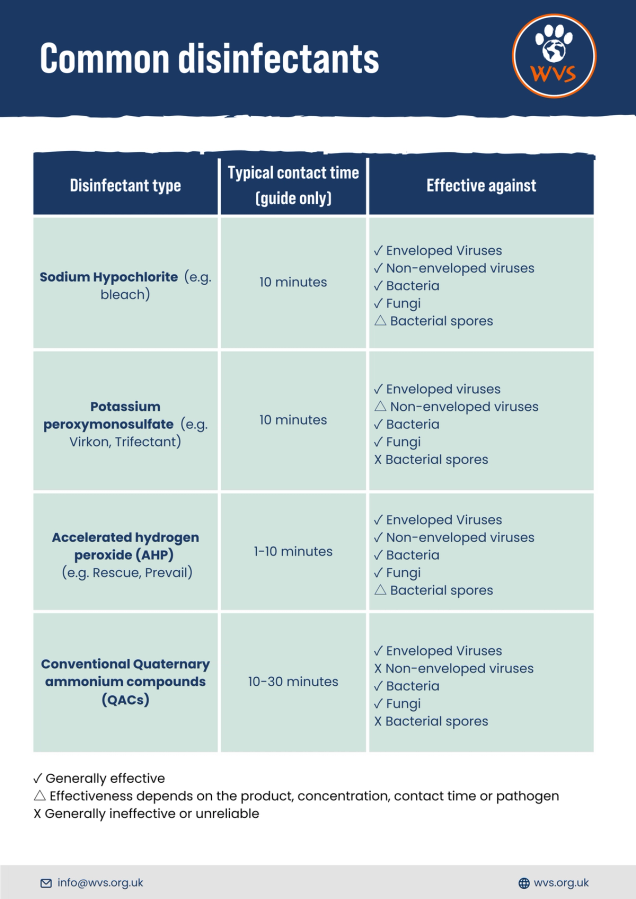
- Oxidising disinfectants damage microbial structures through chemical oxidation. Depending on their formulation, they can be effective against bacteria, enveloped viruses, which are generally easier to inactivate (e.g. canine distemper virus), and more resistant non-enveloped viruses, which can be harder to inactivate (e.g. canine parvovirus). Examples include accelerated hydrogen peroxide (AHP), sodium hypochlorite (bleach) and potassium peroxymonosulfate. AHP and correctly diluted bleach are commonly recommended options against resistant non-enveloped viruses. Some potassium peroxymonosulfate products are specially formulated for use against pathogens such as canine parvovirus. Always check the product guidance to confirm that it is suitable for the pathogen concerned, and follow the recommended dilution and contact time.
- Non-oxidising disinfectants, such as quaternary ammonium compounds (QACs), work mainly by disrupting lipid membranes. They are therefore effective against many bacteria and enveloped viruses, but are not reliable against non-enveloped viruses or bacterial spores. This is because non-enveloped viruses lack an exposed lipid envelope, and bacterial spores are protected by highly resistant outer layers.
Overview information on disinfectant agents
Bleach (sodium hypochlorite)
Bleach is a widely used and cost-effective disinfectant that can be effective against a broad range of bacteria, enveloped and non-enveloped viruses and fungi (e.g. parvovirus, panleukopenia virus, calicivirus, and dermatophytes (ringworm)). Higher bleach concentrations may be effective against bacterial spores, but routine bleach dilutions should not automatically be assumed to be sporicidal.
Bleach must be used correctly in order for it to work properly:
- Bleach does not have any detergent properties itself, and organic matter substantially reduces its effectiveness, so thorough pre-cleaning of surfaces with detergent is essential prior to application.
- For the bleach dilutions and uses described below, bleach requires a 10-minute contact time to achieve full disinfectant action (i.e. surfaces should remain wet for 10 minutes).
- Prepare diluted bleach fresh each day, or sooner if it gets contaminated with organic material (e.g. a dirty mop bucket). Stored, diluted solutions start to lose efficacy after 24 hours.
- Once mixed, the solution should also be protected from light, which causes the solution to degrade more quickly. If you are storing diluted bleach solution in a container such as a spray bottle, it should be opaque or protected from the light.
- Surfaces must be rinsed afterwards to protect animals from a potentially dangerous and irritating residue.
Specific dilution ratios should be followed carefully in order for bleach to work as a disinfectant (correct for a 5.25% concentration):
- 1:32 dilution is effective for general disinfection and for viruses like parvovirus
- 1:10 dilution for disinfection in cases of ringworm.
Household bleach is a commonly used disinfectant and is often found in a 5.25% sodium hypochlorite concentration. However, concentrations can vary between brands and products, so it is vital to verify the percentage before dilution to ensure correct and safe preparation.
Accelerated hydrogen peroxide (AHP) (e.g. Rescue, Prevail)
AHP is a broad-spectrum surface disinfectant that is generally effective against many bacteria, fungi and both enveloped and non-enveloped viruses, depending on the formulation and product label. Some specialist AHP products are also effective against bacterial spores. Certain formulations remain effective in the presence of limited organic matter, although heavy contamination must still be removed before disinfection. An advantage is that many AHP products are safer to handle and less likely to damage surfaces than some traditional disinfectants, such as bleach. AHP is often available in ready-to-use formulations, which reduces preparation time and the risk of dilution errors. However, it may be more expensive and less widely available than household bleach. AHP should not be confused with ordinary household hydrogen peroxide.
Overall, AHP offers a good balance of efficacy, safety and ease of use, particularly in clinical or high-risk environments.
Potassium peroxymonosulfate (e.g. some Virkon and Trifectant products)
Potassium peroxymonosulfate-based products can be effective against a broad range of viruses, bacteria and fungi, making them useful alternatives to bleach (depending on the formulation and product label). Potassium peroxymonosulfate products should not generally be assumed to be effective against bacterial spores unless the specific product carries this claim.
Some formulations retain activity better than bleach in the presence of limited organic matter. However, visible dirt, faeces, blood and other heavy contamination must still be removed before disinfection.
These products may be more expensive and less widely available than bleach. Many are supplied as powders, sachets or tablets that must be dissolved in the correct volume of water. The concentrated product must be handled carefully, as it may cause serious eye damage and skin burns and can be harmful if swallowed. Avoid breathing dust and follow the recommended personal protective equipment guidance. Prolonged contact may damage some metals. In general, surfaces should be rinsed after contact time, to minimise residue risks and prevent surface damage.
Quaternary Ammonium Compounds (QACs)
QACs are commonly used for routine disinfection of low-risk surfaces. They are a group of related man-made chemicals used in many disinfectants. There are several different types and names, and products may combine more than one QAC with other ingredients.
Conventional QAC disinfectants are usually effective against many bacteria, enveloped viruses and fungi, including ringworm-causing fungi (always check the product label). However, they are not effective against bacterial spores and are generally unreliable against non-enveloped viruses such as parvovirus.
Organic contamination can reduce their effectiveness, so surfaces should be cleaned before the disinfectant is applied. During an infectious disease outbreak, you should always choose a product that is specifically recommended for the pathogen concerned (a QAC might not be the correct choice e.g. for parvovirus).
How to recognise a QAC product
Check the active ingredients for names such as benzalkonium chloride, alkyl dimethyl benzyl ammonium chloride or didecyldimethylammonium chloride (DDAC). Some products combine QACs with other ingredients, so always check the product’s full efficacy information.
Some products commonly described as QAC-based disinfectants (e.g. formulations of the brands F10 and Trigene) also contain other ingredients. These combination formulations can have a broader range of activity than conventional QAC disinfectants and may be effective against particular non-enveloped viruses, fungi or bacterial spores, providing you follow the instructions for concentration and contact time stated on the label.
Generally, QACs are most suitable for routine disinfection and should not be relied on during high-risk outbreaks unless the specific product is approved for the pathogen concerned.
Caution: some disinfectants contain phenolic compounds, which can be harmful to cats. Ingredients vary between products and even within the same brand, so always check the label before use.
The properties of these products are summarised in the table below:
Important information
This article provides general guidance only. Disinfectants with the same active ingredient can differ in strength, formulation, approved uses and effectiveness, and products may vary between countries. Before use, check that the product is suitable for the pathogen, surface and setting. Follow the label and safety data sheet for dilution, contact time, cleaning, rinsing, PPE, storage and disposal. During an infectious disease outbreak, also follow relevant veterinary, public-health and local disease-control guidance.