

Not all disinfectants work on all types of pathogens. It’s important to consider the type of microbes that might be present, when choosing the most appropriate disinfectant. The information below provides an overview of how susceptibility varies between different microorganisms. There is more information on specific disinfectants and their modes of action in the next article.
Common pathogens and their level of susceptibility to disinfectant agents:
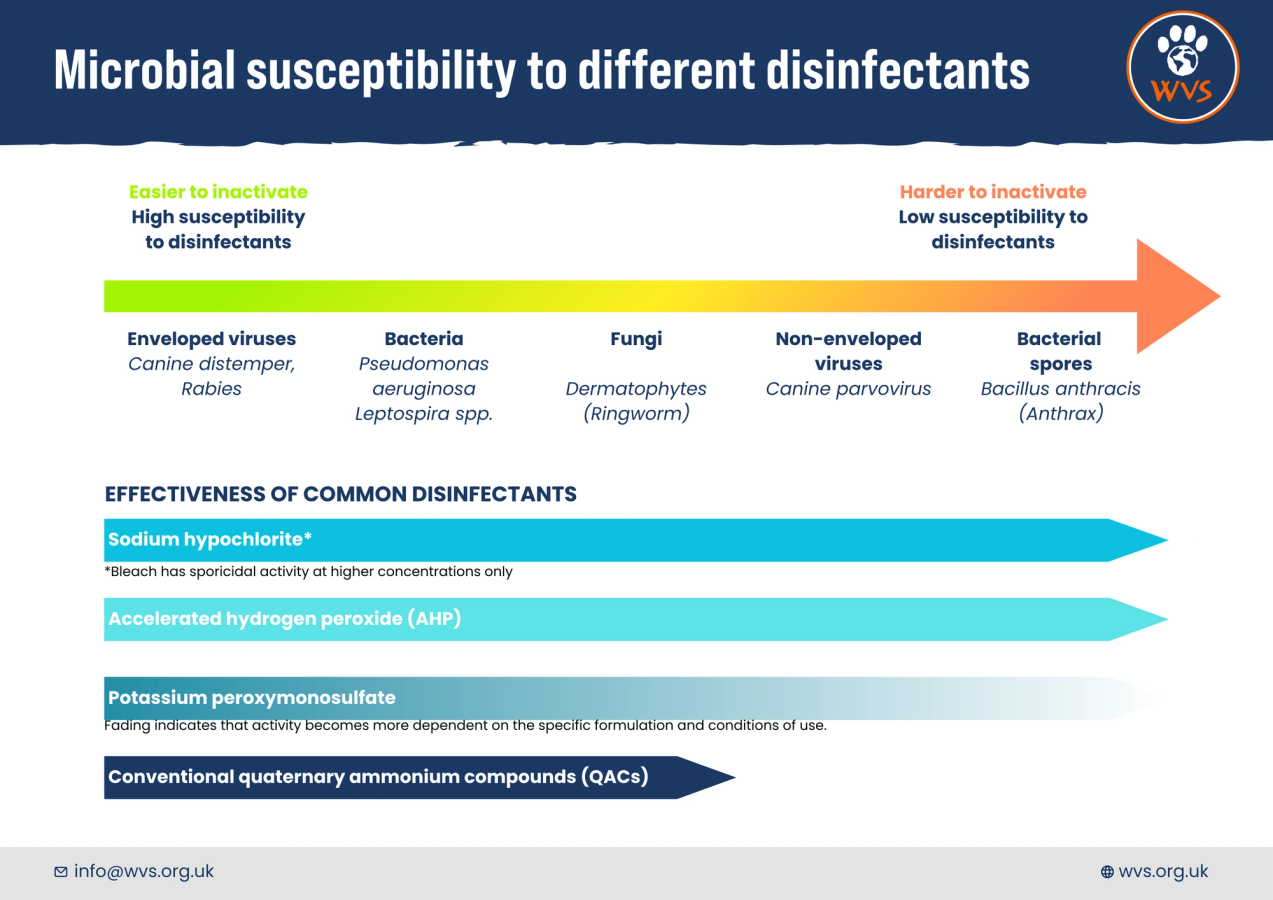
- Enveloped viruses (e.g. canine distemper) are among the most susceptible to disinfectants due to their outer lipid envelope, which is a useful target for disinfectants.
- Bacteria, including most Gram-positive and Gram-negative bacteria, are generally susceptible to a wide range of disinfectants when these are used correctly. Gram-negative bacteria have an outer membrane that can provide some additional protection, and certain Gram-negative bacteria, such as Pseudomonas aeruginosa, may be more difficult to control, particularly when present in biofilms. Bacterial spores are considered separately (see below) because they are much more resistant.
- Fungi, including the dermatophytes that cause ringworm, are generally more resistant to disinfectants than enveloped viruses and most bacteria. However, their susceptibility varies, so it is important to use a product with proven fungicidal activity against the target pathogen.
- Non‑enveloped viruses (e.g. canine parvovirus) are highly resistant because they lack a lipid envelope and instead have a sturdy protein capsid. This means that many routine disinfectants, including conventional QACs, do not reliably inactivate them. They require a disinfectant with demonstrated activity against the virus concerned, such as correctly diluted bleach, AHP or some potassium peroxymonosulfate formulations.
- Bacterial spores are among the most resistant microbial forms. Their highly durable structure enables survival under extreme conditions such as drying, heat, and exposure to many chemicals. Effective inactivation requires disinfectants with proven sporicidal activity.
What is a bacterial spore?
Some bacteria, including Bacillus and Clostridium species, can form highly resistant, dormant structures called bacterial spores when conditions become unfavourable. Unlike ordinary, actively growing bacterial cells, spores have tough protective layers that allow them to survive drying, heat and many disinfectants. They can later return to an active bacterial form when conditions improve. Bacterial spores are different from fungal spores.
The diagram below provides a simplified overview of microbial susceptibility and the general activity of common disinfectant groups.
Choosing a disinfectant is based on more than just susceptibility - read the next articles to learn more.