
Static point vaccination can be the most efficient of all the vaccination methods - a team stand in one place and vaccinated a constant stream of dogs all day long, enabling one vaccinator to inject hundreds of dogs in a day. But it relies entirely on an engaged dog owning public who are motivated and able to bring their dogs for vaccination.
The static point vaccination method involves setting up temporary vaccination clinics at locations throughout a community and requesting people to bring dogs for vaccination. It is the most easy to scale vaccination approach, however requires good planning and knowledge of the local setting to be effective.
Distribution
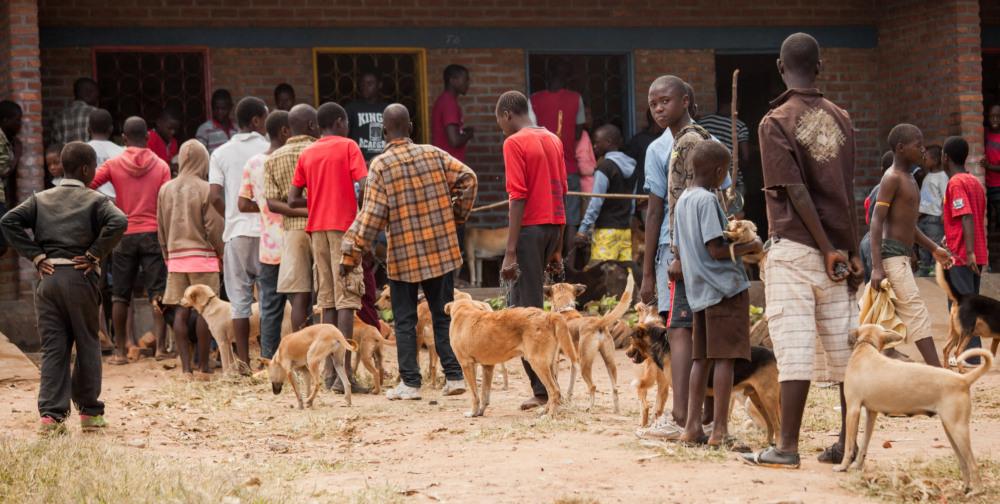
Static points should be distributed in a way that ensures that all communities are serviced by a close static point. Some static points in high-density regions may have thousands of people and their dogs present in a single day, whilst others may have just a few. Where static points are well attended it can be beneficial to run them across two or three sequential days or run numerous clinics in close proximity to ensure that everyone in the community is able to get their dog vaccinated during the campaign.
Poor turnout. Static point clinics rely on people bringing their dogs and so it is not a good use of resources to continue to run static point clinics that are not performing well - the cost of salaries and logistics are not justified if too few dogs are vaccinated in a day. Campaign data should be reviewed to assess the performance of each static point and where turnout is very low, for example less than 20 dogs per day, remedial action should be taken in subsequent campaigns. This can be by either increasing awareness in the community, repositioning the static point clinic, or substituting for door-to-door vaccination.
In low density areas it may not be cost-effective to go door-to-door or conduct a roaming static point approach (see below).
Team structure
There should be a minimum of two people in each static point vaccination team to run a static point clinic. Single person teams should be avoided from perspectives of safety and efficiency. Multiple vaccination teams should be combined to run clinics where turnout is expected to be large, enabling the workforce to be combined to manage larger crowds. Typically a vaccination team of three people can manage a clinic with a turnout of approximately 250 dogs per day (40 dogs per hour). If turnout is expected to be more than this, an additional team should be added to create a combined workforce of 6 people and two vaccinators to vaccinate up to 500 dogs.
Roles
The same individuals may take on multiple roles, however it is important that everyone in the team knows who is responsible for what. Typically a static point vaccination team will consist of two to three people (Figure 1). Typically the team do not require a vehicle of their own as they will stay at the static point all day. This means that one vehicle can transport multiple teams and their equipment to and from their designated vaccination clinics at the start and end of each day, thus reducing vehicle costs.
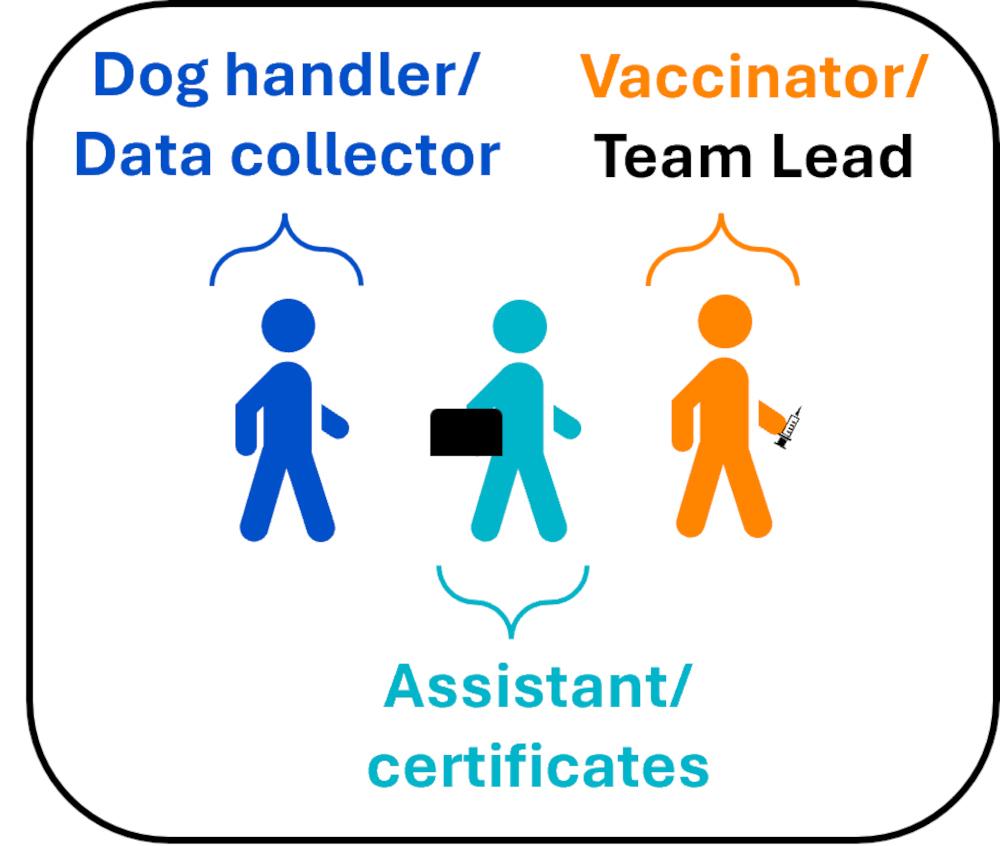
Roles within a static point team include:
- Vaccinator. Someone is responsible for vaccinating and marking the dogs. They should be supported by the team to maximise vaccination throughput.
- Dog handler.Dog owners should be instructed how to restrain their dog, however where they are not able to, someone in the team needs to be able to step in to assist so that the flow of dogs is not slowed and dog welfare is upheld.
- Assistant. At larger clinics the flow of dogs to the vaccinators can be constant and assistants need to be be constantly drawing vaccine into syringes to ensure vaccinators can focus on vaccinating dogs.
- Data collection. of every dog vaccinated. It is best that this is someone working in the vaccination space, typically an assistant or the vaccinator themselves, to make each entry at the time of vaccination to avoid discrepancies in the data.
- Queue management. For higher turnout static points, someone in the team is likely to be required to manage the queue of people and dogs to keep order.
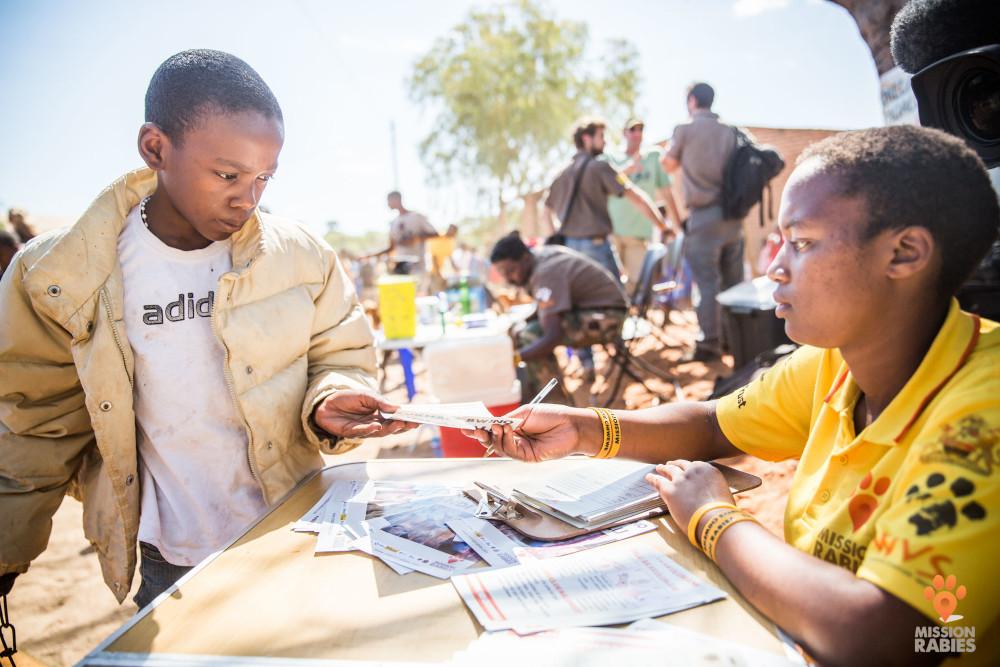
- Issuing vaccination certificates. Many governments require dog owners to be issued with a certificate of vaccination. The writing and issuing of certificates can be a time consuming task where hundreds of people have brought dogs for vaccination. Certificates can be pre-written and someone is responsible for ensuring these are issued in a correct and orderly way, typically after the vaccination area so that the dog can be confirmed to have been vaccinated due to the presence of the vaccination mark (Figure 2).
Equipment
In addition to the standard vaccination team equipment (here), static point teams should also carry:
- Foldable tables and chairs (if not available at the central point location)
- Cones and tape for crowd management
- Campaign banner to place at the entrance to the clinic
Static Point clinic management
Without good management and planning, there is the potential for static point clinics to become chaotic as crowds of people bring their dogs for vaccination. This can increase the likelihood of dogs fighting and people getting bitten, which is not an environment that will encourage people to bring their dogs for vaccination and presents a risk to health. Running an organised clinic creates a professional impression to the public to build confidence in the overall campaign. The vaccination team must establish a systematic flow of people from arrival, through to a gated admission to a vaccination area and then on to a station for the issuing of a vaccination certificate.
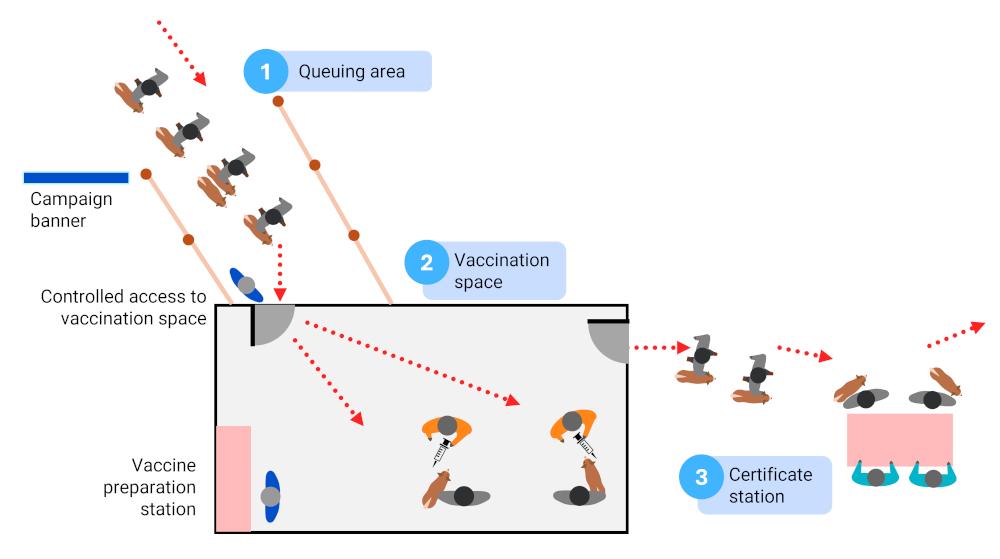
- Queuing area. People and their dogs waiting for vaccination need to be organised into a queue to ensure a fair sequence of vaccination. The location chosen for the static point clinic should consider an area large enough to accommodate the expected number of people in a queue. A campaign banner should be clearly visible from the entrance of the site to direct people to the start of the queue.
- Vaccination space.The vaccinators should have a designated space which is kept clear so that dogs (and their owner) are separated from the crowd for vaccination. Whilst not always possible, it is ideal to have the vaccination space inside a room or area to which access can be controlled. This has the advantage of reducing noise to help dogs to settle and require less restraint, but also makes it easy to re-catch any dog that escapes their leash as the owner tries to hold them for vaccination. Where a room is not possible, a defined vaccination space should be created from other barriers at the clinic location. An assistant should control dogs and owners entering the space so that the next person is only allowed to enter once a vaccinator is available. An organised, clean area should be created within the vaccination space for the drawing up of vaccines so that vaccinators have a constant supply of prepared vaccine. Figure 4 - Dogs are marked with non-toxic marker at the time of vaccination so that unvaccinated dogs are easily identified.
- Certificate station. After vaccination, owners should be directed to a certificate station to be issued with a vaccination certificate as they leave the vaccination space (Figure 4). Each dog is checked for a paint mark to confirm vaccination status and vaccination certificate given to the owner.
Roaming static point vaccination
It is typically ineffective to position static points in areas of low population density, as daily turnout is often too low to justify the cost of running the clinic. An alternative approach is the ‘roaming static point’ (RSP) approach. When conducting this method, teams set up temporary static point locations at prominent locations in a community and broadcast to local dog owners to bring dogs for vaccination. Oncer the rate of dogs drops off, the team pack up and move to a different part of the vaccination zone and repeat the process. Over the course of the day, the team may conduct 10 - 20 of these static point stations, ensuring that every household in the community has had the opportunity to attend a nearby vaccination point.
To be successful, communities must be engaged and willing to bring their dogs for vaccination. Pre-awareness campaigns and pre-determined dates are typically needed for the RSP method to achieve sufficient coverages. Where people are not able to leash their dog or are unable to bring them for vaccination, more resource intensive methods, such as door-to-door are needed to reach adequate vaccination coverages in the population.