
The subject of harnessing and cart design is large and covers many areas. As a veterinary professional or student you are not expected to know all the details. However a basic understanding of the principles of harnessing allows you to understand why injuries occur and look for preventative measures as part of a team approach. Although it is good to treat harness related injuries, ideally prevention is more sustainable using local resources and knowledge.
The aim of this article is to enable a basic understanding of:
- The weight an equine can pull
- Problems related to poor harness
- Parts of a harness and cart
- Recognising good and bad harness
- Approach to improving harness and cart design
The weight an equine can pull
The usually accepted amount that an equine can pull is three times their body weight, while maintaining adequate health. However in hard terrain (uphill, with soft surfaces etc) this may fall to 0.5- 1.5 times the equines’ body weight.
There are a number of variables that affect the load carrying capacity of an equine including:
- Their physical fitness, body condition score, strength, illness, wounds, nutrition, hydration, rest and age. A young skeletally immature equine can pull less than an equine of the same weight that is a fit, well conditioned adult. Draft breeds of horses with thicker metacarpal bones and good bone density can pull more than finer breeds of horses.
- Equine care - if the equine is provided with regular rest, water and feed they can work better than if dehydrated, exhausted and hungry.
- The terrain - the surface that the load is pulled over has a large influence on the amount that can be pulled. Smooth roads are clearly easier for pulling a cart than through mud and sand. Working on gradients- up and down hill provide additional challenges.
- Weather conditions - working in extreme heat or cold, without access to shelter for rest, will reduce work output and the load that can be pulled.
- The cart - there are many things to consider here such as the vehicle weight, maintenance of the moving parts including the tyres, and cart design.
- The harness - good harness that fits the animal well and is clean and well maintained will improve the ability of the equine to work.
- Weight distribution of load - the load should be carried 1/3 in the front of the cart and 2/3 in the rear for heavy loads. Figure 1 has been widely shared on social media and shows the severe impact of an excessive and unbalance load. The stress on the mule depicted is unimaginable.
- Type of work - work that is fast or with frequent sharp turns, stops and starts is more exhausting than a steady smooth type of work pattern.
- Owner skill, knowledge and behaviour - there is a high degree of skill in caring for an equine, and training and working them in harness. An owner who understands how to care for their equine and has empathy for them, will sustain a better working relationship with that animal.
Problems related to poor harnessing
Overloading
Overloading is a major problem wherever equines are used, and may be worse when they are hired-out rather than been used by one owner, as there will be less concern for their long term use and welfare. When considering the load being pulled, the weight of the cart and the driver needs to be included in the calculation of how much weight should be on the cart. Overloading is recognised by a change in gait and behaviour of the equine. Typically donkeys and horses become slower, may stumble more, and have more lameness. Behaviourally they show reluctance to move, tail lashing, head bobbing and excess movement of the head.
Physiological indicators of overloading include elevated heart rate with slow return to normal, increased temperature and respiratory rate. There is a also a build up lactate and increase in muscle enzymes.
Reduced work life
When equines are consistently overloaded there is a high turnover of animals as they cannot sustain the load bearing. This results in their sale into poorer working conditions, abandonment and premature death.
Wounds
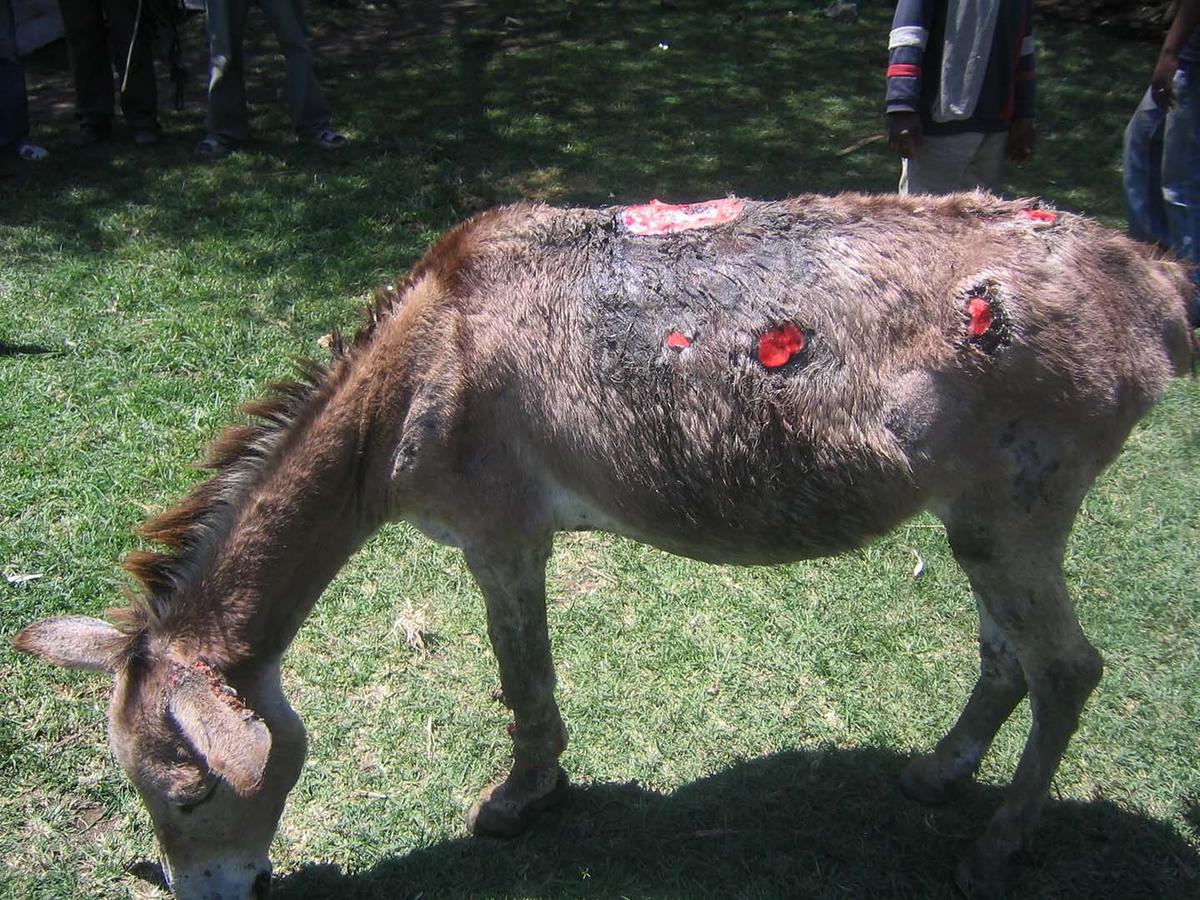
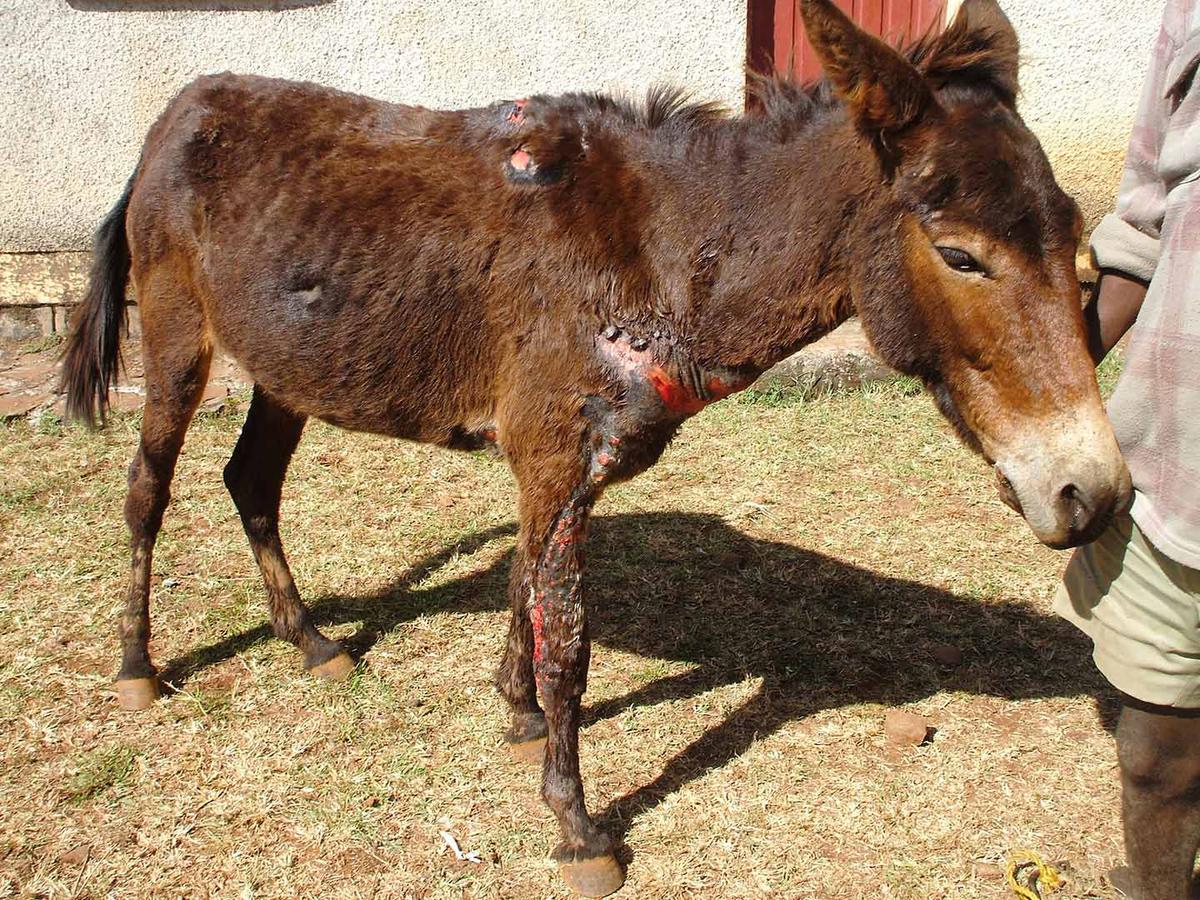
Poor harness and cart design can lead to widespread wounds. Figure 1 shows a donkey with wounds present at most of the contact points between his skin and the cart harness. Wounds are a welfare issue and reduce the ability of the equine to work well.
Infections secondary to wounds
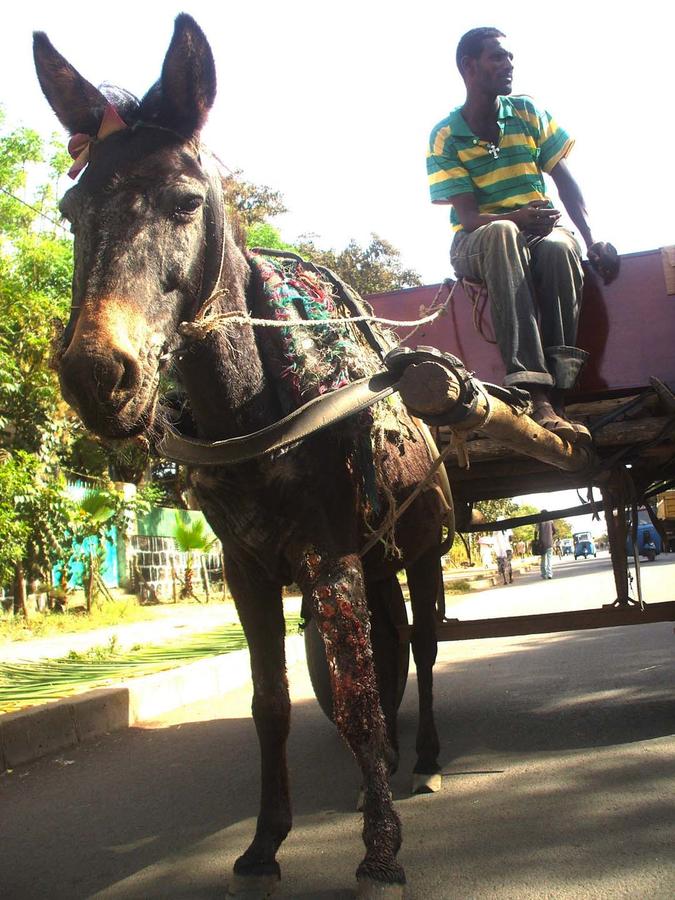
The most serious infections seen in working equines from harness related wounds are tetanus and epizootic lymphangitis (EZL). Infection enters through breaks in the skin barrier at sites of harness rubs. Figures 2 and 3 show a cart mule working in Ethiopia affected by EZL; lesions start at the location of harness sores then spread through the lymphatics:
Breakdown of human-animal relationship
It is an economic necessity for working equines to continue to pull carts and carry loads. Without their motive power owners cannot make a living and provide for their family. If an equine cannot work well, is slow or unwilling to work due to pain, the owner may force the animal to work using harsh methods. This leads to anxiety, fear and potentially aggression from the equine which worsens the situation, and can lead to escalating cyles of violence towards the equine.
Reduced work output and owner income
Working equines are responsible for livelihoods of those that work with them and their dependents. If the equine is injured, wounded or sick, the owner suffers financial hardship.
📚 This open access link provides an in depth overview of welfare problems of draft equines
Parts of a harness and cart
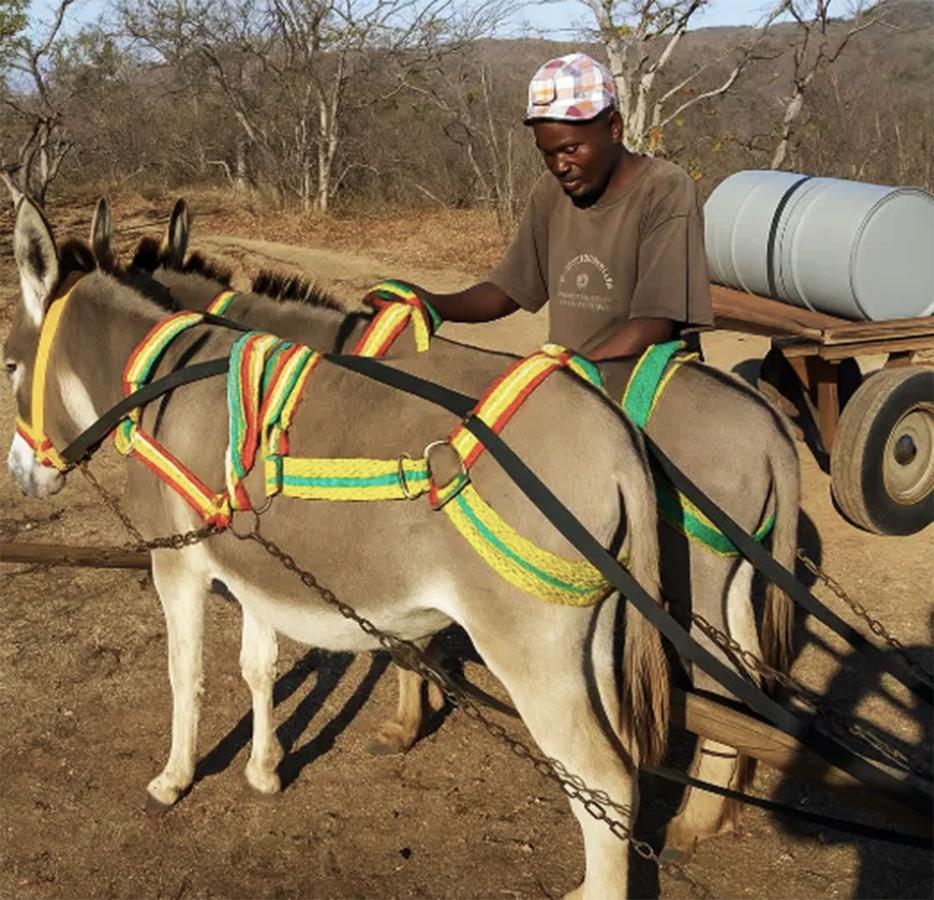
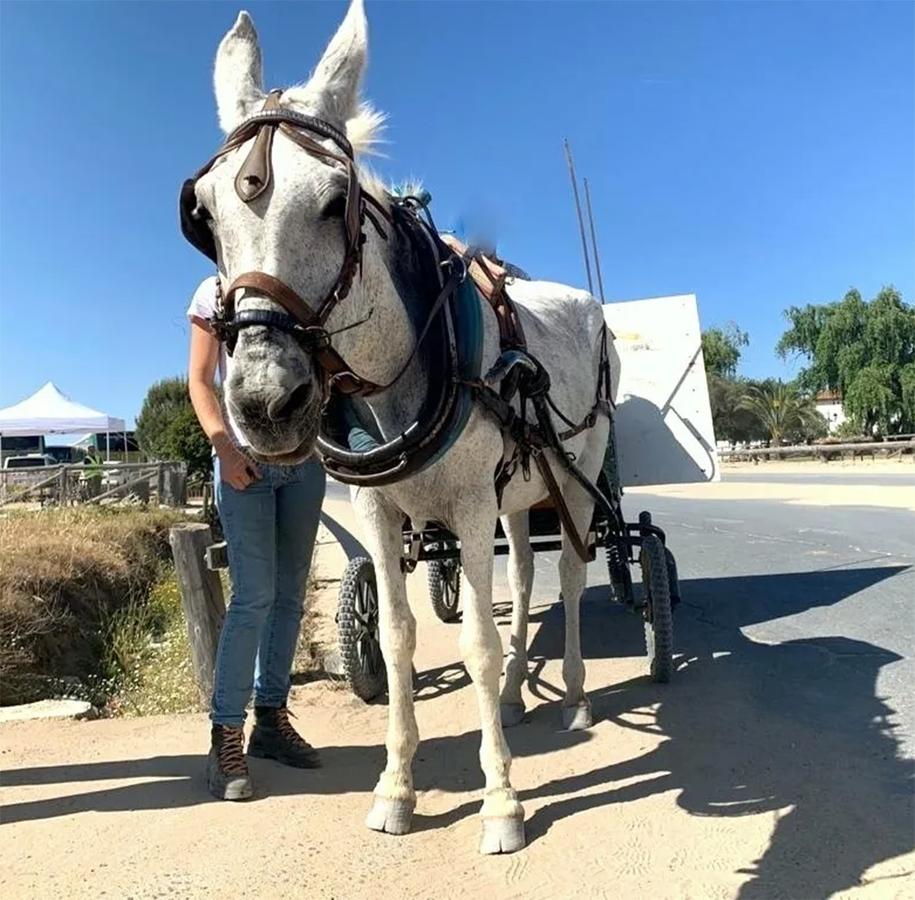
The ability to transfer the power of the equine to a loaded cart depends on the harness, and although there are numerous variations and additions the essential parts remain similar. Table 1 and Figure 4 explain the essential parts of a harness used by one equine to pull a cart. This should be read in conjunction with the Good Harness Guide produced by The Donkey Sanctuary. There are many occasions when two equines are worked together to pull a cart, this can be two equines side-by-side, or one behind another. The basic principles are the same, but there are some additions. To understand how two equines can be harnessed side by side the following resource should be consulted.
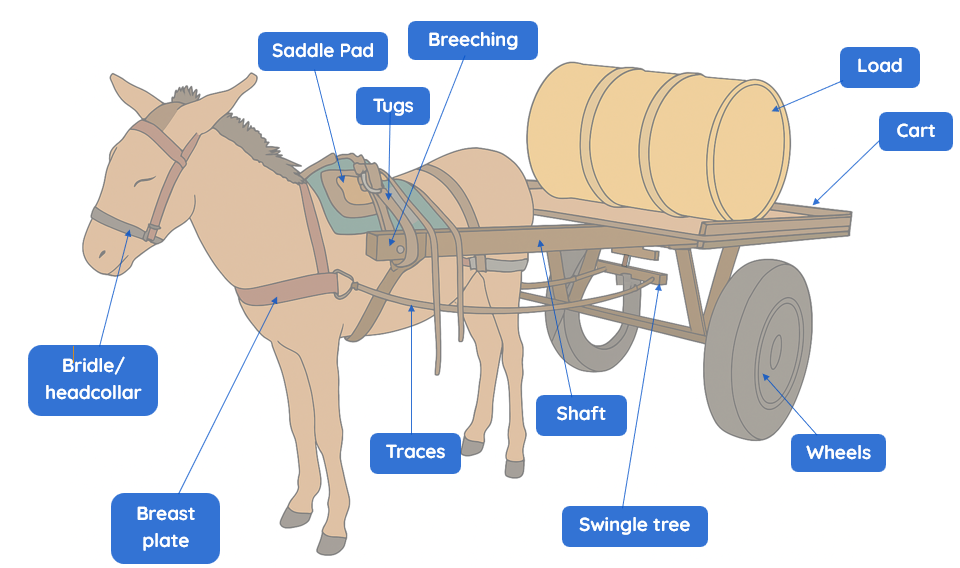
| Part of harness | Role | Comments |
|---|---|---|
| Headcollar or bridle with reins | To control the head, assist with braking and steering | Bit and bridle should not be tight, the bit should just wrinkle the corners of the mouth, and fit 1cm on either side outside the lips. |
| Breast plate (Figure 4) | To transfer the pushing power of the equine to the pulling forward of the cart. Should be connected by straps to breeching. | Should not restrict breathing or interfere with forelimb movement. |
| Breast Collar (Figure 6) | May be used instead of a breast plate | Should not restrict breathing or interfere with forelimb movement. |
| Saddle pad (figure 4) | To provide anchors for tugs that support the shafts of the cart | Wide enough not to pinch and with gullet space to avoid contact with the spine. |
| Tugs (figure 4) | Straps that support the shafts of the cart | Sufficient needed to distribute the weight evenly. |
| Back strap | To support the breeching and crupper that keeps the harness from slipping to the sides. Attached to the breast collar, or strap in front. | This prevents the harness slipping so needs to fit well but not be overtight. |
| Breeching (figure 4) | Straps that fit below the buttocks to provide a braking system for the cart | Without breeching the equine finds it hard to brake and can be injured going downhill or stopping abruptly |
| Crupper | Strap that comes from backstrap and fits under tail to prevent the harness from slipping forwards | Often too tight or made of narrow abrasive material |
| Traces (figure 4) | Attach breast plate of collar to the swingletree. Transmits force from harness to swingletree | |
| Swingletree (figure 4) | Allows free movement of the equines forelimbs while still moving the cart forward. Attaches to the breast plate or collar in front and the cart behind. | Without a swingle tree the breast plate or collar will rub on the points of contact with the shoulder |
| Shafts of cart (figure 4) | Supported by tugs.Two shafts for a one animal cart, but usually only one central shaft if the cart is to be pulled by two equines. | Ideally parallel to the ground so that the load is pulled horizontally |
| Cart | Numerous types, can be extremely heavy. | Cart balance is vital to loading. A balanced cart requires less effort to pull than one which is heavily unbalanced from side to side or back to front. |
| Wheels and tyres | Smooth movement of the cart depends on good wheels | Rubber tyres are preferable to old fashioned wooden tyres with metal rims |
| Eveners | Used to enable two animals to work alongside each other. | Placed in front and behind equines when working in parallel, and attached to swingle trees. |
Table 1 Parts of a cart and harness
Recognising good and bad harness
A harness should be examined all over, to look for how well made and comfortable it is and any wounds caused by it. The harness may need to be removed for a thorough examination. Some areas to consider are:
Harness Fit; ensure that harness is not overtight, there should be room for a hand to pass under straps. Look particularly where contact is made such as the girths and crupper/tail rope. Breast straps or collars should be on the widest part of the chest, to allow clearance for the windpipe and no restriction of shoulder movement.
Materials; Natural fibres and breathable materials are less likely to cause rubbing. Synthetic fibres that do not allow sweat to evaporate are less comfortable. Narrow materials such as rope concentrate forces in a small area compared to wide straps. Rubber become excessively hot when used in warm climates and makes poor padding.
Cleanliness; Harness that is dirty with accumulations of sweat and grime promote skin irritation and bacterial infection of wounds.
Approach to improving harness and cart design
Community work
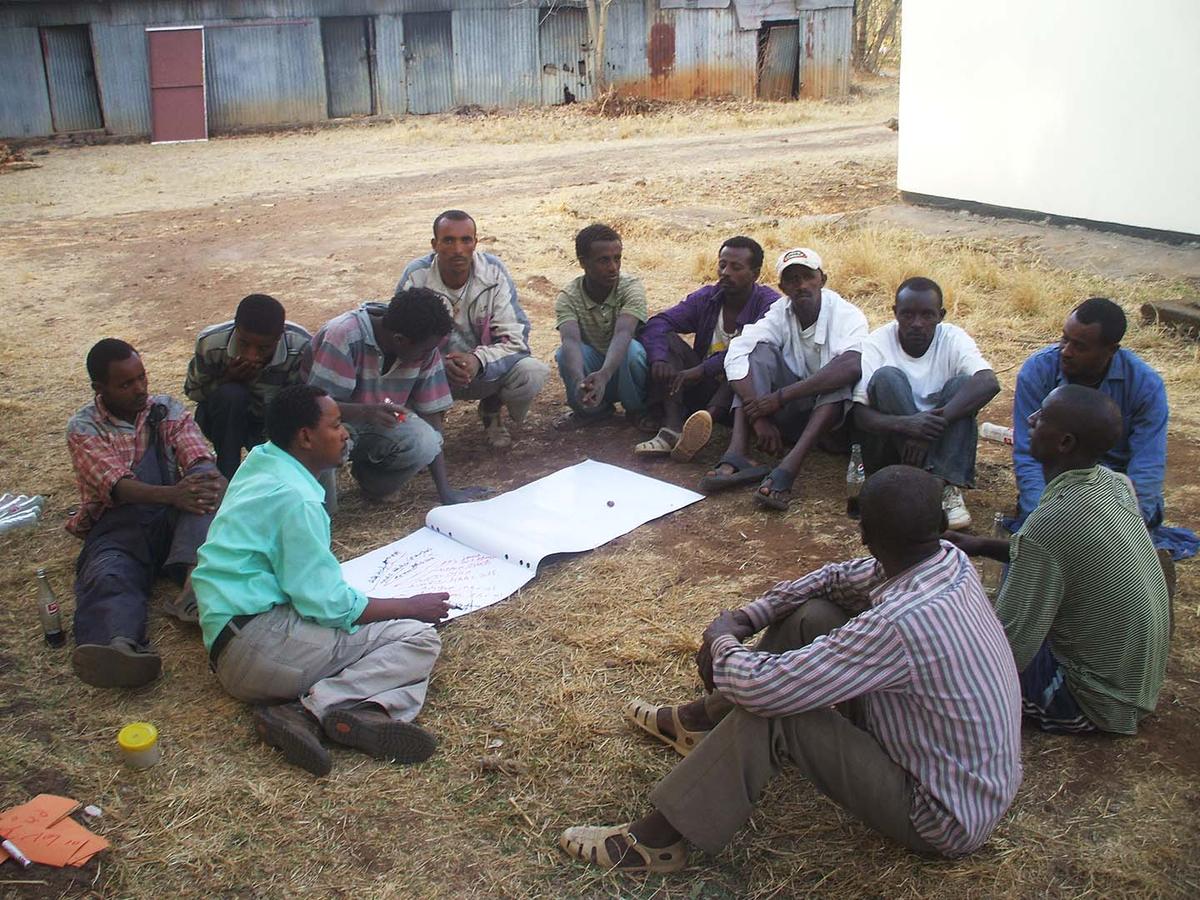
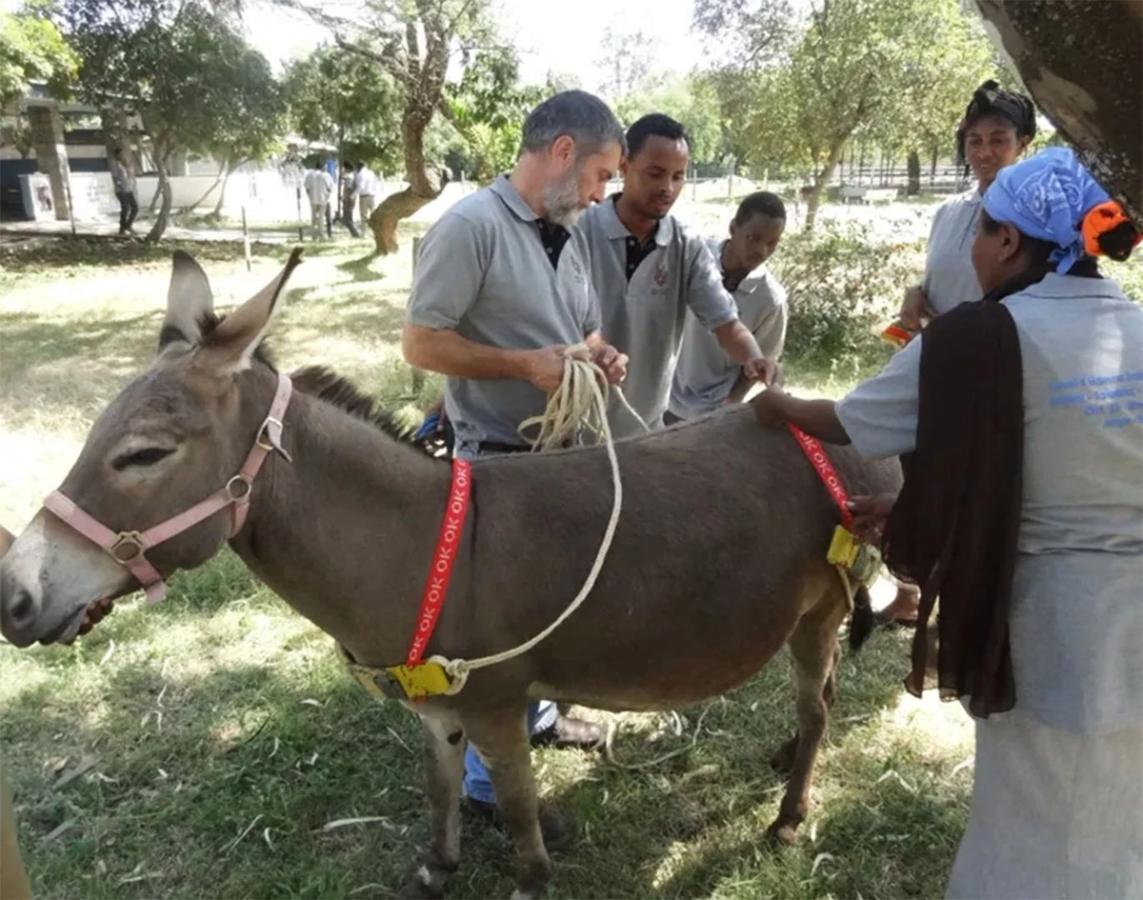
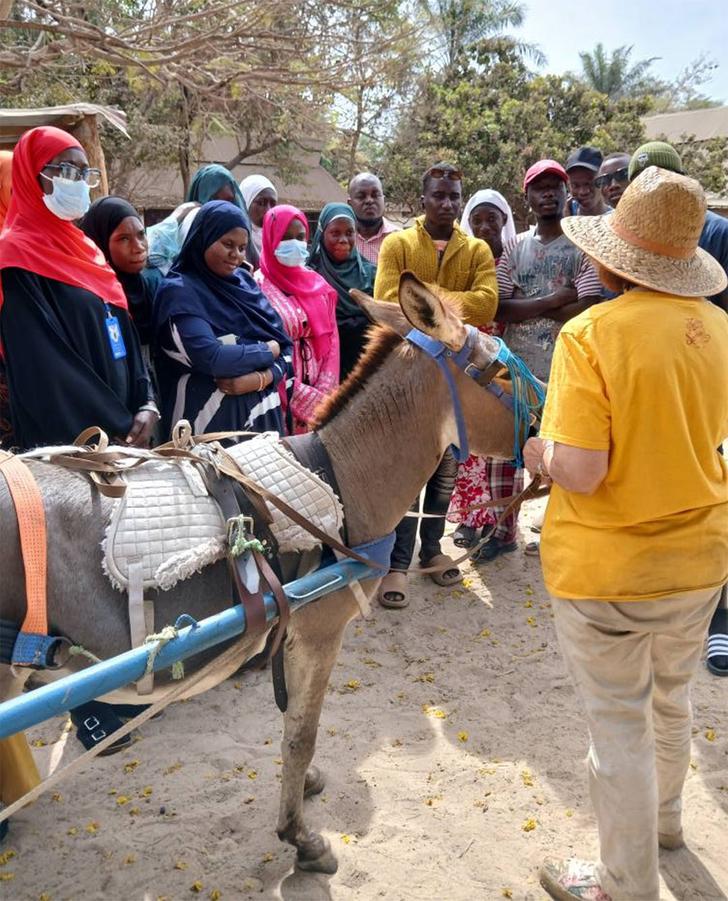
The only way to create long lasting change and improvements in harnessing is through engagement with and training of communities that work with the equines (figures 7-9). This is slow work requiring the development of trust and incentives to change. Successful working equine projects use this method and a train the trainer approach to achieve solutions that last. Ideally the materials for making and mending the harness should be sourced locally, although in some cases donated equipment can be used a template for designing good harness locally.
Liaising with local officials
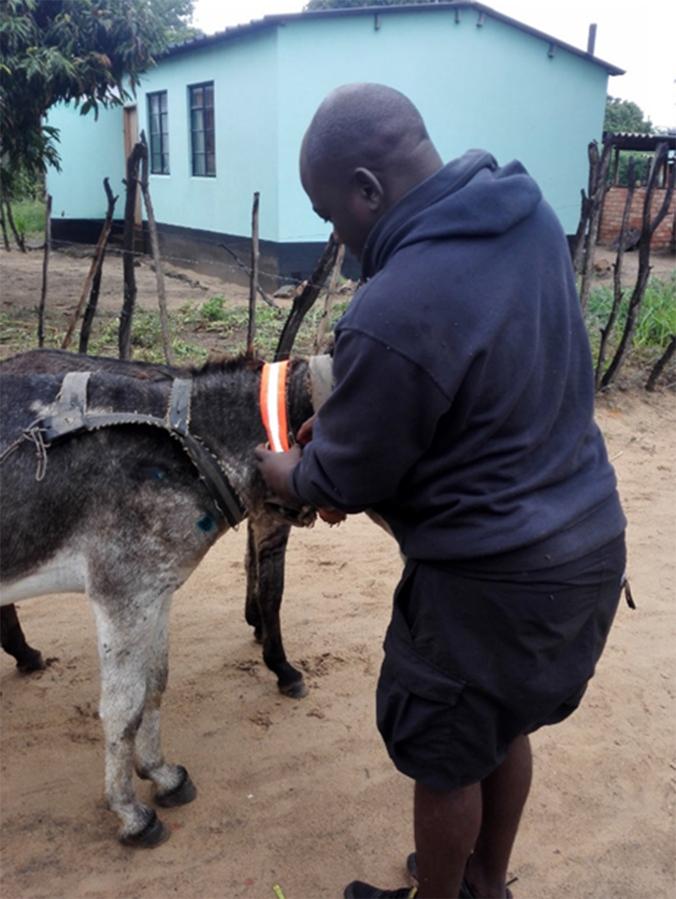
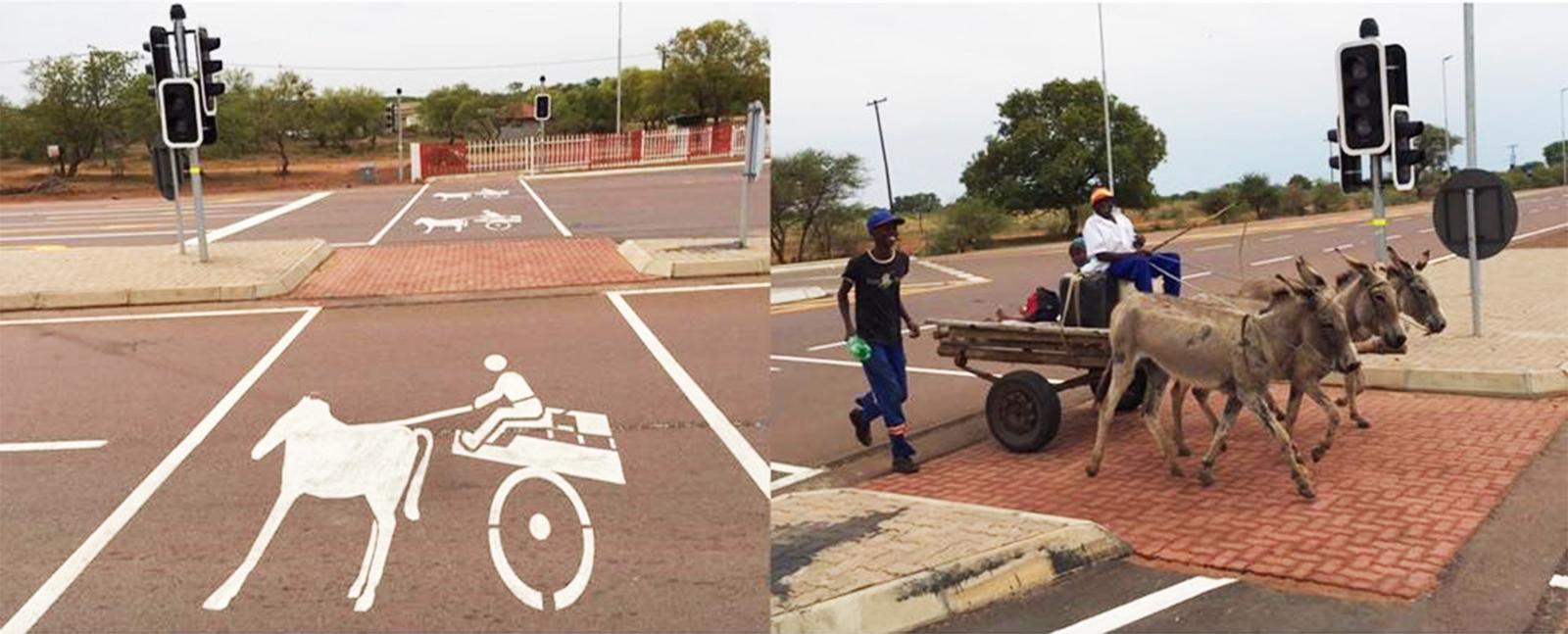
Equines that are worked in harness in urban and periurban areas are often injured in road traffic accidents. Simple solutions such as applying flourescent markers to carts and animals can increase their visibility at night and reduce accident rates. More complicated and expensive solutions rely on separating equines from vehicles with dedicated lanes for motor and equine traffic.