

Urine dipsticks are a cheap way to gain a range of useful information to help with a diagnostic work up of your patient, even if you do not have access to a microscope. Dipsticks contain square pads infused with chemicals. The chemicals react with products in the urine to give a visible colour change, which corresponds to a semi-quantitative result on the chart.
Not all parameters can be used for our veterinary patients; this is because dipsticks are calibrated for human use. The image below summarises which tests are appropriate and which should be avoided:
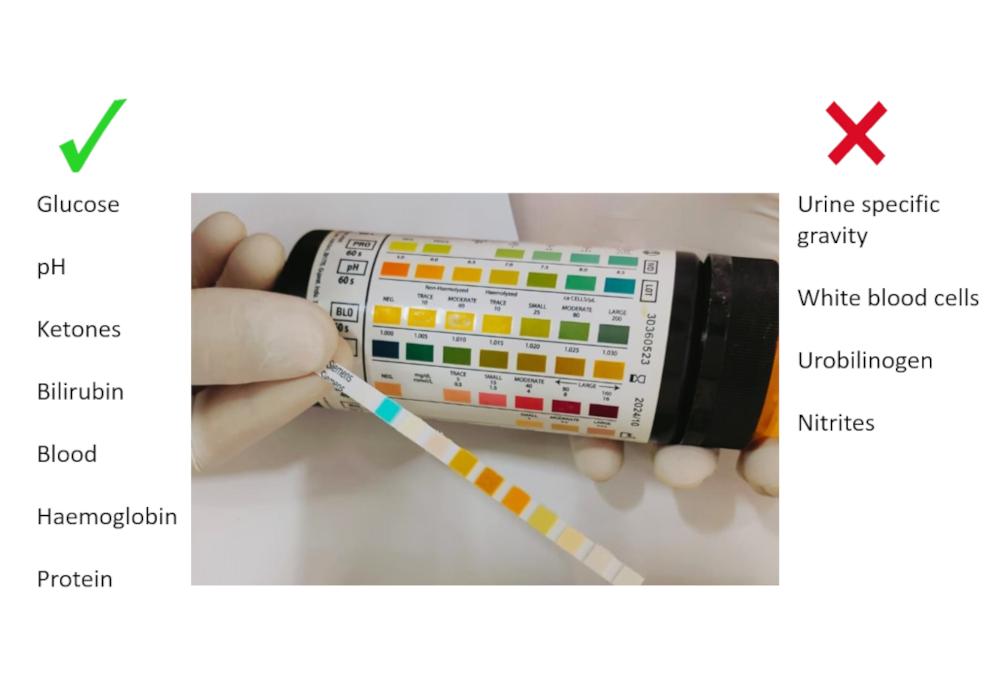
Method
The dipstick may either be dipped into the urine (and any excess gently tapped off onto a paper towel), or urine may be pipetted onto the individual squares. The clinician then compares the colour of each individual square against a reference chart. The chart will indicate the time at which each section of the dipstick may be read.
Interpretation
Each parameter is discussed below:
pH. An accurate estimation of pH can be obtained when tested with a fresh sample. Increased pH (increased alkalinity) may be due to a urinary tract infection (with urease-producing bacteria), sample ageing, metabolic (or respiratory) alkalosis, or dietary influences. Decreased pH (increased acidity) may be due to renal tubular acidosis, metabolic (or respiratory) acidosis, as well as dehydration or dietary factors.
Glucose. This should be negative. It is detected in the urine once blood glucose increases above the renal threshold and the excess is excreted. Its presence may indicate hyperglycaemia, such as in cases of diabetes mellitus or a stress response in cats. Otherwise blood glucose may be normal, but dysfunction to kidney tubules results in reduced glucose resorption which passes into the urine instead. Continued glucosuria increases the risk of urinary tract infection (UTI).
Blood glucose can be measured using a glucometer and a simple skin pin-prick test.
Ketones. This reading should be negative. Ketone presence in urine may suggest ketoacidosis (e.g. diabetic), severe starvation/anorexia (leading to catabolism), or a very high fat diet.
Bilirubin. Small amounts of bilirubin may be normal in dogs with very concentrated urine. However, it is always considered abnormal in cats. It may be increased in cases of intravascular haemolysis, liver dysfunction or cholestasis.
Blood. This should be negative. A positive reading indicates bleeding in the urinary tract (due to infection/inflammation, trauma, neoplasia or coagulopathy). Consider whether an entire female may be in oestrus (if it is a free catch sample).
Haemoglobin. This also should be negative. Positive results may be due to erythrocytes breaking down as the urine sample ages, or due to intravascular haemolysis. Myoglobinuria may be present in the case of muscle damage.
Protein. This should be negative or only be detected in trace amounts. However, it is important to assess alongside urine specific gravity (using a refractometer), as up to 2+ protein may be normal in very concentrated urine. Blood in the urine may also cause a false positive protein reading, but only if the blood is grossly visible on examination of the sample. Interpret with caution as false positives and negatives are possible.
The presence of protein may be due to pre-renal causes (e.g. intravascular haemolysis, myoglobinuria), renal causes (e.g. glomerular or tubular pathology), or post-renal causes (e.g. semen, prostatic disease, oestrus, urinary tract infection).
If available, a UP/C (urine protein: creatinine) ratio can be a useful, additional tool to gain a quantitative measurement of proteinuria. This may require sending the sample to an external lab. It can be considered if there is no other immediate explanation for proteinuria (e.g. urinary tract infection, haematuria), and if dipsticks are consistently reading positive for protein on multiple samples. UPC ratio compares protein levels in the urine to the level of creatinine, which is excreted at a constant level. This provides a frame of reference to consider whether protein levels in the urine are truly increased.
Dipstick tests for UPC have not been fully evaluated for accuracy.