

Urine specific gravity measures the concentration of an animal’s urine. This enables assessment of kidney function (i.e. its ability to concentrate and dilute urine), hydration levels, and other underlying health conditions. It is a cheap, easy and useful technique to aid in a diagnosis.
We measure urine specific gravity (or USG) with a refractometer. Do not use the dipstick assessment of specific gravity, as it is inaccurate.
Calibrating the refractometer
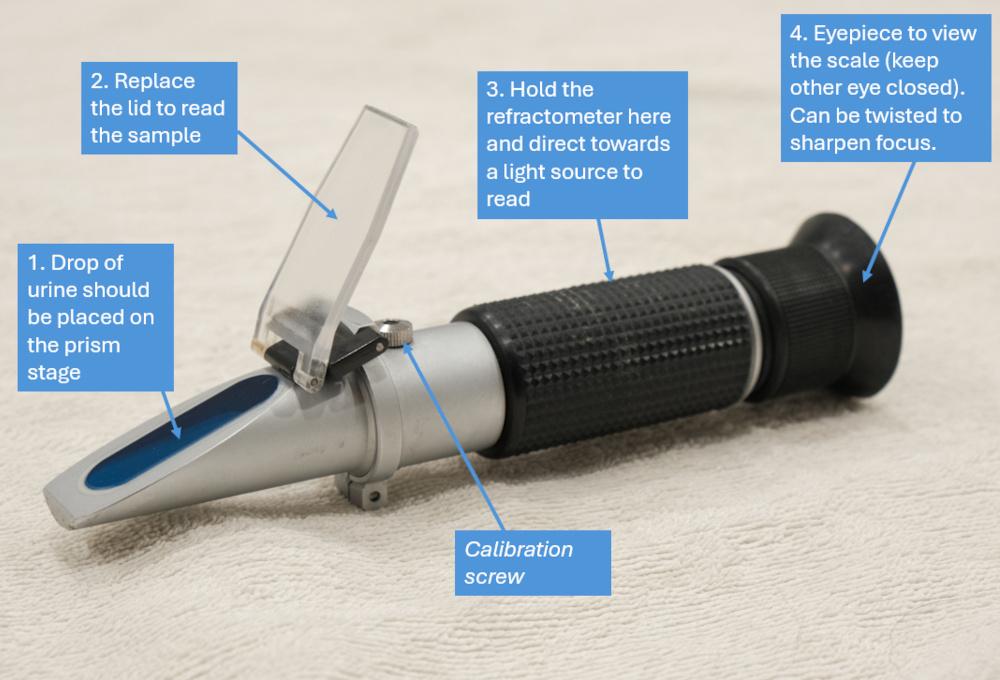
Refractometers must be calibrated before use, using distilled water.
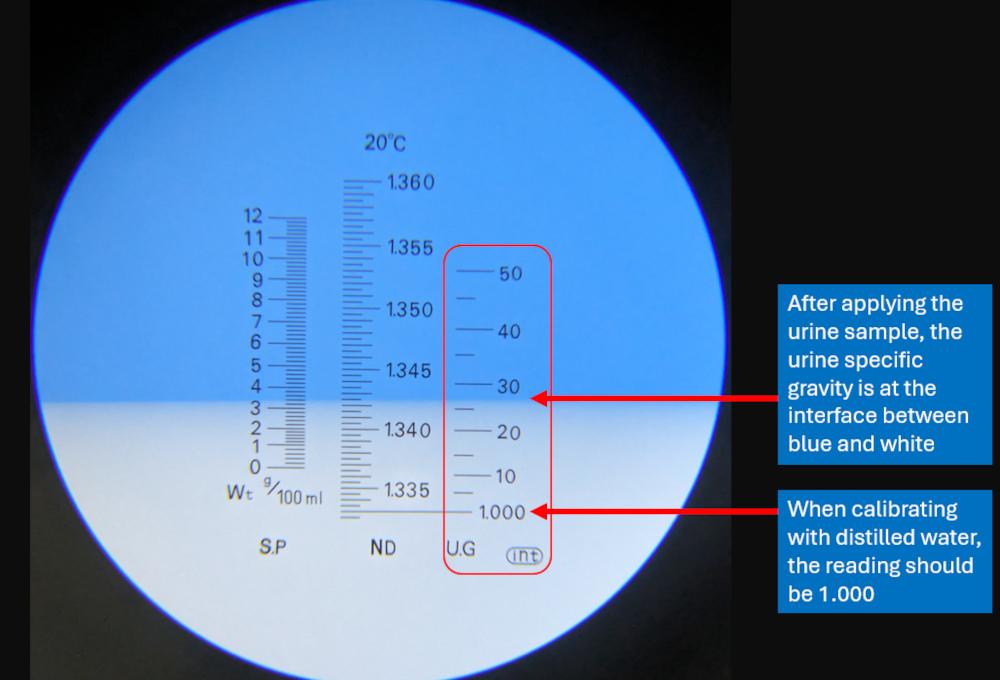
- Place distilled water on the refractometer. Replace the cover and look through the eye piece. It helps to hold the refractometer towards a light source so you can see the display clearly. Find the scale which measures specific gravity; the reading for distilled water should be 1.000 (see Figure 3).
- If the reading is correct, the refractometer can then be gently wiped clean with a dry cloth, and urine can be tested. If not, you need to recalibrate the refractometer.
- The refractometer may be calibrated by adjusting the calibration screw upwards (to bring the scale down) or downwards (to bring the scale up) until the reading reaches 1.000. The screw can be adjusted using a screwdriver - usually one is provided with the equipment.
Measuring urine specific gravity
- Using a pipette, place a drop of fresh urine on the refractometer stage.
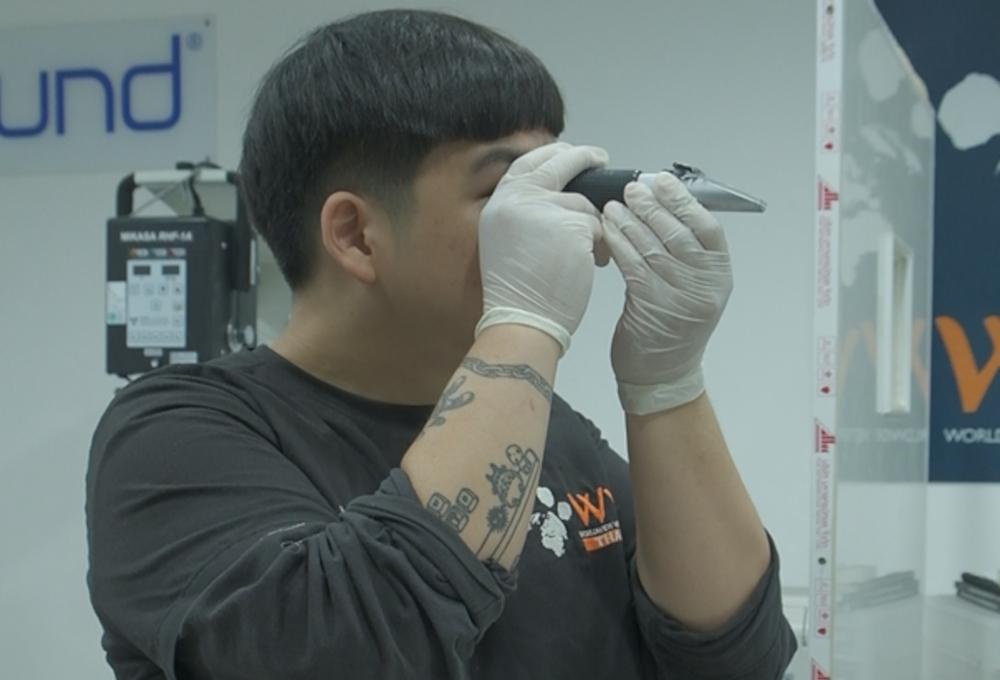
- Close the lid and direct the refractometer towards a light source.
- Read the specific gravity number off the chart visible through the eyepiece.
Interpretation
USG can vary widely in healthy animals, ranging between 1.015 - 1.045 in dogs and 1.035 -1.060 in cats. Morning samples may have a higher USG, particularly in dogs.
All interpretation of USG should be made alongside consideration of other factors including:
- concurrent disease
- hydration status
- blood urea nitrogen and creatinine
- urine glucose and protein
- recent therapy
The table below summarises the classifications of USG that help to determine the functioning status of the kidneys.
Table 1. Classification of USG
| Urine Specific Gravity | Concentration | Possible interpretation |
|---|---|---|
| >1.030 in dogs, >1.035 in cats | Hypersthenuria: well-concentrated urine | The kidneys concentrating ability is functioning well (at least 1/3 of nephrons are working). |
| 1.013-1.029 dogs, 1.13-1.034 in cats | Minimally concentrated | Interpret alongside hydration status- considered inappropriate if concurrent dehydration. |
| 1.008-1.012 | Isosthenuria: not concentrating or diluting (same as blood plasma). | The kidneys are neither concentrating nor diluting urine. May be normal, but when present alongside azotaemia, renal failure should be considered. |
| <1.008 | Hyposthenuria: actively diluting. | The kidneys are functioning to actively dilute the urine (at least 1/3 of nephrons are working). Considered inappropriate alongside dehydration/ azotaemia. Interpret alongside other clinical signs and consider other disease processes. |
Dilute urine may be considered appropriate in a well-hydrated patient who is, for example, on fluid therapy, but would be considered inappropriate in a patient who is dehydrated. As a general principle, readings below 1.030-1.035 should be considered as possibly abnormal in the presence of azotaemia or dehydration (inappropriately dilute urine).
Readings should be repeated on multiple samples for a reliable interpretation of a patient’s USG.
Note that severe glucosuria and proteinuria may increase USG readings, producing falsely concentrated results. Readings may also be lower in very young animals.