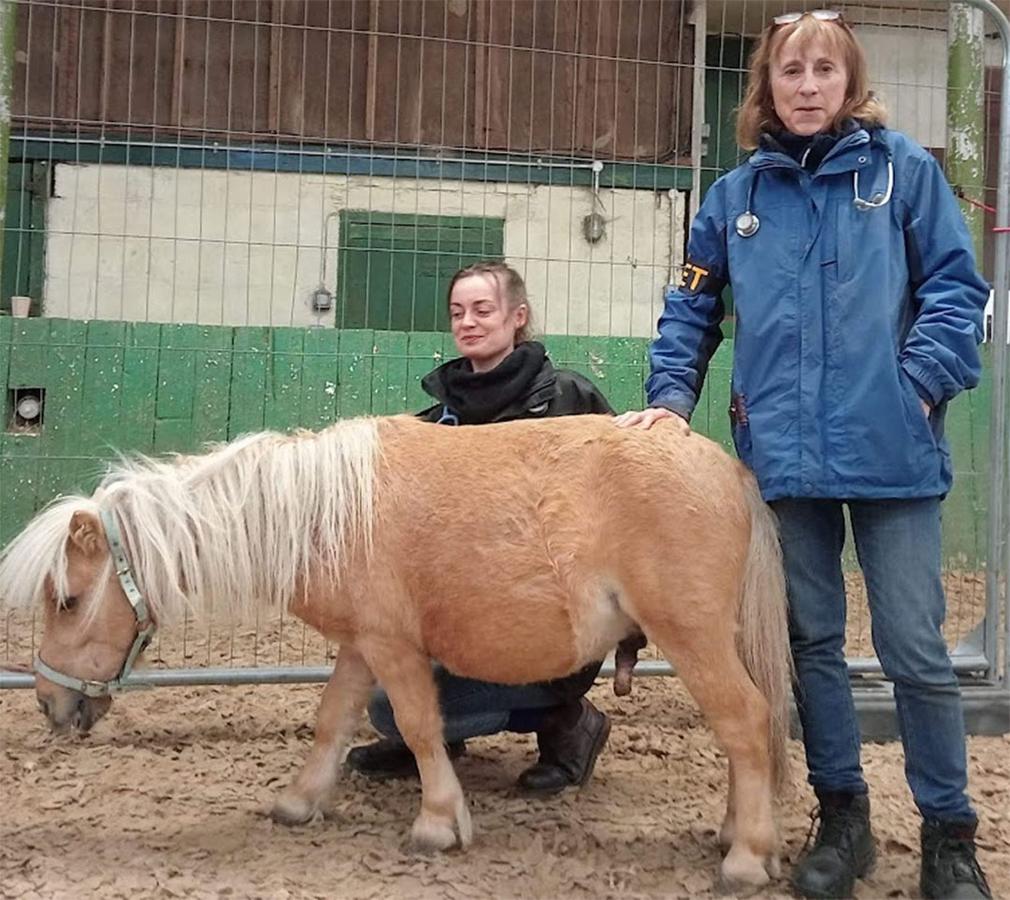

Indications
Sedation is a useful procedure when needed and allows veterinary surgeons to undertake many minor procedures in a welfare friendly and safe manner. It can allow procedures to be done standing which is safer for the equine, and avoids the use of harsh restraint. Indications for sedation include :
- Routine procedures; for example dental rasping with a gag to allow good visualisation of the molars and safety of the operator, specialised farriery, gynaecological procedures, and radiography
- Colic exam; for performing a rectal examination, passing a nasogastric tube and taking a peritoneal tap
- Dental procedures; more dental procedures are now performed in standing sedated equines with the use of local anaesthetic nerve blocks
- Wound management and wound suturing, when combined with local anaesthetic
- Lameness examination and nerve blocks; using short acting sedation can make using nerve blocks much safer
- Joint blocks and joint flushes; those of the lower limb can be performed in standing sedated patients
Alternatives
Owners often ask for equines to be sedated as it can seem like an easy option to perform. However in many cases equines become averse to venepuncture and become stressed by the vet visit knowing that an injection is inevitable. When the horse/donkey becomes aroused the sedation dose will be less effective and this sets up a vicious cycle of escalating use of sedation. For routine management procedures such as clipping, farriery, vaccinations etc. is is far preferable to use alternative methods including:
- Calm handling with experienced personnel; this can be remarkably effective - when people are anxious themselves, anxiety can be transmitted to the patient
- Food rewards and distractions; correctly used to reward a ‘standing still behaviour’, these can remove the need for sedation in some cases. Having a relaxed companion equine close by can act as a good calming presence
- Behaviour shaping plans; this involves breaking down an aversive experience into many small manageable steps, using positive rewards. This type of work is very suited for equines with fear to procedures such as clipping, farriery or venepuncture but is not suitable for painful procedures (see video link below)
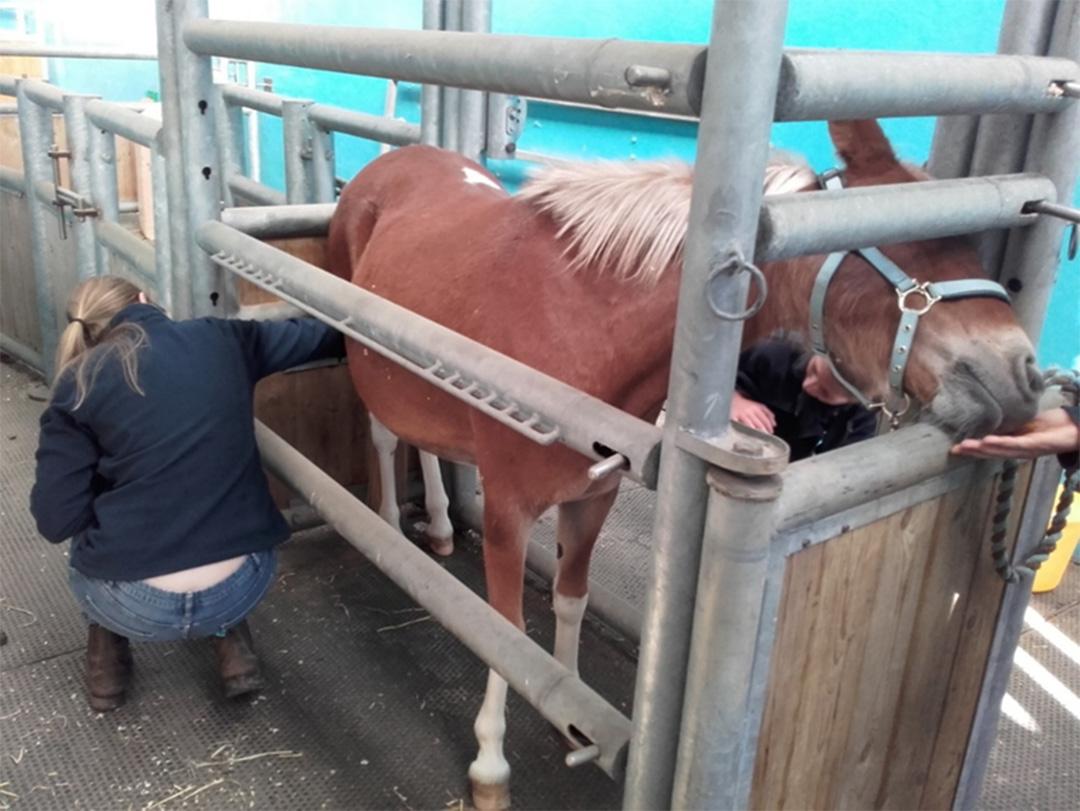
- Stocks; these may be more practical to use with extremely fearful equines that are unhandled. Placing them in well designed stocks can be calming and allows the vet/handler to approach and make examinations safely (figure 1)
- An upper lip twitch - this can provide good short term restraint in emergency situations. Mules and horses tolerate them well, they are harder to place on a donkey and often less effective. A twist of neck skin can provide temporary distraction. An ear twitch should never be used, as they create a dangerously head shy equines for the future, and are considered inhumane.
This series of videos ‘Don’t break your vet’ by Dr Gemma Pearson, an equine behaviourist, introduces the concept of shaping plans and behaviour modification for horses:
Medications
Dosages are provided from the British Equine Veterinary Association formulary, and the NOAH compendium.
Acetyl Promazine - ACP (table 1)
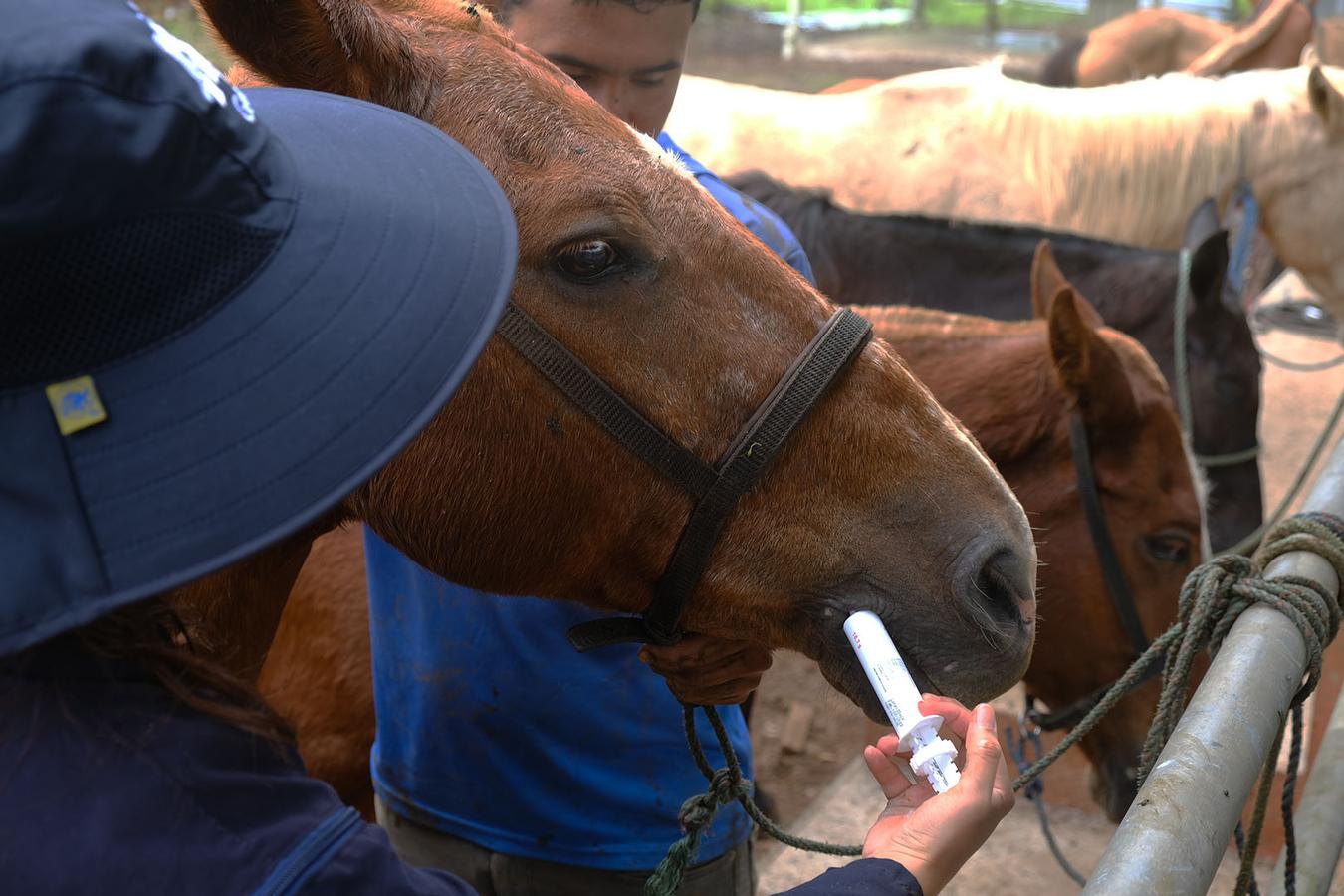
This sedative provides a mild anxiolytic and is useful for some procedures. It is often given to help equines with laminitis as the relaxation encourages equines to lie down and rest their hooves. Owners can administer this in an oral paste (figure 2).
💡 ACP is not an analgesic so pain relief must be given additionally if required. ACP causes hypotension and should be avoided in equines suffering dehydration, colic or haemorrhage
- ACPs effects are long lasting; 4-6 hours, so equines need a long rest period after use
- The drug is often used as part of a pre-anaesthetic protocol
- ACP combined in a syringe with Detomidine and Butorphanol can be a useful combination for unhandled mules as it achieves profound sedation via an intramuscular route
- ACP 0.03mg/kg + Detomidine 0/02mg/kg + Butorphonal 0.05mg/kg
| Medication | Route | Dose | Comments |
|---|---|---|---|
| ACP | oral | 0.08-0.22mg/kg | mild sedation only, anxiolytic |
| intravenous (IV) | 0.02-0.06mg/kg | Hypotension may last longer than sedation. Avoid in intact males as can cause penile prolapse. | |
| Intramuscular (IM) | 0.03-0.1mg/kg | Hypotension may last longer than sedation. Avoid in intact males as can cause penile prolapse |
Table 1 ACP dosages and routes of administration
Alpha-2 agonists
These drugs are all commonly used and vets tend to have their own preferences, depending on familiarity and procedure. Xylazine is often used for when a short acting sedative is required, whereas romifidine gives minimal ataxia and is considered useful for radiography. All these drugs have similar side effects (table 2):
- Do not give 20 minutes before or after intravenous trimethoprim sulfadiazine as fatal cardiac arrhythmias can occur
- Side effects include ataxia, bradycardia, respiratory depression, and reduction in gastrointestinal motility
- Donkeys may need the upper end of the dose ranges quoted. Mules may need 1.5 to 2 times the doses quoted if they are unused to handling.
- Alpha agonists provide mild analgesia
- Combination with opioids in a neuroleptanalgesia combination is used to provide enhanced sedation
- Atipamezole at 0.1-0.2mg/kg can be used to reverse the effects of alpha 2 agonists if required
Detomidine provides deep and profound sedation with marked ataxia at high doses. Owners can administer sublingual detomidine as a licensed product, however it is poorly effective if swallowed and works best when absorbed across the mucous membrane
| Medication | Route | Dose | Comments |
|---|---|---|---|
| Detomidine | sublingual | 0.04mg/kg | The drug must be given sublingual for absorption across the mucous membranes. If swallowed it is ineffective |
| IV | 0.01-0.02mg/kg | Use lower dose in at-risk equines | |
| IM | 0.02-0.05mg/kg | Use between 1.5-2 X the IV dose and allow 15-20 minutes before starting a procedure | |
| Xylazine | IV | 0.2-0.8mg/kg | Shorter acting - up to 20 minutes, lower doses useful for nerve blocks |
| IM | 0.5-2.2mg/kg | Use higher dose for donkeys and up to 1.5-2 x for mules | |
| Romifidine | IV | 0.04-0.08mg/kg | Produces less ataxia, but also less analgesia |
| IM | 0.1-0.2mg/kg |
Table 2 Alpha-2 agonist dosages and route of administration
Opioid/ alpha-agonist combinations (neuroleptanalgesia)
In ambulatory equine work the most usual neuroleptanalgesic combination involves an alpha-2 agonist and butorphanol, allowing small dose volumes and rapid onset of activity (table 3). The combination of drugs is particularly useful in sedation for a painful procedure and reduces the risk of the equine kicking.
| Alpha-2 agonist | Butorphanol | Comments |
|---|---|---|
| Detomidine 0.01-0.02 mg/kg IV | 0.025mg/kg IV | Use upper end of dose range with donkeys, and 1.5-2 x dose range with mules |
| Xylazine 0.5- 1mg/kg IV | 0.05-0.1mg/kg IV | |
| Romifidine 0.04-0.12 mg/kg IV | 0.02mg/kg IV |
Table 3 Alpha-2 agonist and butorphanol, dosages and routes of administration
Diazepam/Midazolam
These drugs are used as sedatives in neonatal foals, usually via the IV route (table 4). They can aid in procedures such as IV catheter placements. In adult horses these drugs are used as part of an induction protocol with ketamine as they help induce muscle relaxation, but not sedation. Diazepam must be used soon after been drawn up into a syringe as it reacts with plastic.
💡 Diazepam and Midazolam are not analgesics so pain relief would need to be administered additionally if required
| Medication | Route | Dose | Comments |
|---|---|---|---|
| Diazepam | IV | 0.02-0.2mg/kg | Use lower dose in compromised neonatal foals at 0.1mg/kg |
| IM | 0.1-0.2mg/kg | IV route preferred | |
| oral | 0.02-0.2mg/kg | Oral bioavailability nearly 100% | |
| Midazolam | IV | 0.02-0.1mg/kg | Used in foals for sedation |
| IM | 0.1-0.2mg/kg | Used in foals for sedation |
Table 4 Diazepam and midazolam dosages and routes of administration
Safety aspects
Sedation of an equine certainly can make a difficult job a lot easier, but there are some safety concerns to be aware of:
- Ataxia; sedated animals can be profoundly ataxic, or even fall over, where possible ensure there is a suitable surface to stand on that will not damage an equine if it stumbles/falls (figure 3).
- Kicks; sedated equines can still kick with surprising force, always be very spatially aware when dealing with a sedated animal
- Feed/Water; sedated equines should not have access to food or water until they are awake and have control of swallowing, this time varies with the sedation used (figure 2)
- Colic; many sedatives reduce gastrointestinal motility as a side effect of their action. If used in high doses, the reduced motility can cause post sedation colic and bloat
- Environmental extremes; sedated equines thermoregulate poorly and should not be left exposed to extreme heat, cold or wet
- Avoid use in equines with underlying health issues - liver, renal failure, dehydration, severe stress
- ACP acetyl promazine can cause penile prolapse in stallions and should be avoided. In young equines undergoing castration the risk is minimal
- Pregnancy; sedation with alpha 2 agonist in equine pregnancy should be avoided, as they increase intra-uterine pressure
- Human self-injection or mucosal absorption should be treated in hospital as there may be bradycardia, respiratory depression, hypotension and cardiac arrhythmias