
Maintaining a high standard of cleanliness in consult rooms and clinical areas is essential to minimise the risk of cross‑contamination between patients. These areas experience frequent contact with animals and people, so thorough cleaning protocols are required.
Surfaces with high levels of patient contact, such as treatment tables and weighing scales, must be cleaned and disinfected between each patient. All used equipment should also be cleaned and disinfected as appropriate. There are detailed instructions on how to clean equipment in the next article.
Cleaning and disinfection involve:
- Cleaning with a general-purpose detergent to remove visible debris, organic matter, and surface contamination. This step is crucial, as disinfectants are significantly less effective on dirty surfaces.
- Applying the chosen disinfectant according to the manufacturer’s recommended contact time to achieve effective disinfection.
See our other articles, e.g. ‘General cleaning guidelines’ and ‘How to use disinfectants’, for more practical guidance.
High‑touch surfaces
All high‑touch surfaces, particularly those that come into direct contact with patients, must be cleaned and disinfected between every patient. This includes:
- Examination tables
- Weighing scales
In addition to surfaces that come into direct contact with animals, several shared or frequently touched areas also harbour contamination and must be cleaned and disinfected routinely throughout the day. These include:
- Desks and worktops
- Computer keyboards, mice and touchscreens
- Door handles and drawer fronts
- Light switches and power controls
- Telephones, pens and clipboards
These areas should be wiped down at scheduled intervals, with increased frequency during busy periods and after known contamination.
Walls and vertical surfaces
Although often overlooked, walls and other vertical surfaces should be regularly cleaned as they can become contaminated through splashes or contact with animals. Areas next to examination tables, weighing scales and seating should be prioritised. This helps reduce the accumulation of pathogens, dander, saliva and environmental debris.
Enhanced disinfection for high‑risk patients
For patients suspected or confirmed to have an infectious disease, enhanced cleaning protocols are required. After the initial detergent clean:
- Use a broad spectrum disinfectant that has demonstrated efficacy against the target pathogen. In many cases, an oxidising agent (e.g. accelerated hydrogen peroxide) may be appropriate, when available.
- If oxidising agents are not available, a correctly diluted bleach solution at the appropriate concentration and contact time may be an effective alternative.
- Pay particular attention to any surfaces or equipment that the animal touched.
- See the later articles on isolation for more information on enhanced cleaning/disinfection protocols.
Sweeping and mopping
Floors are one of the most frequently contaminated areas within a veterinary clinic. Hair, dirt and bodily fluids can easily accumulate and be spread throughout the environment via foot traffic, equipment and animal movement. Regular sweeping and mopping are essential to reduce environmental contamination and prevent pathogens from being redistributed between areas.
Good practice includes:
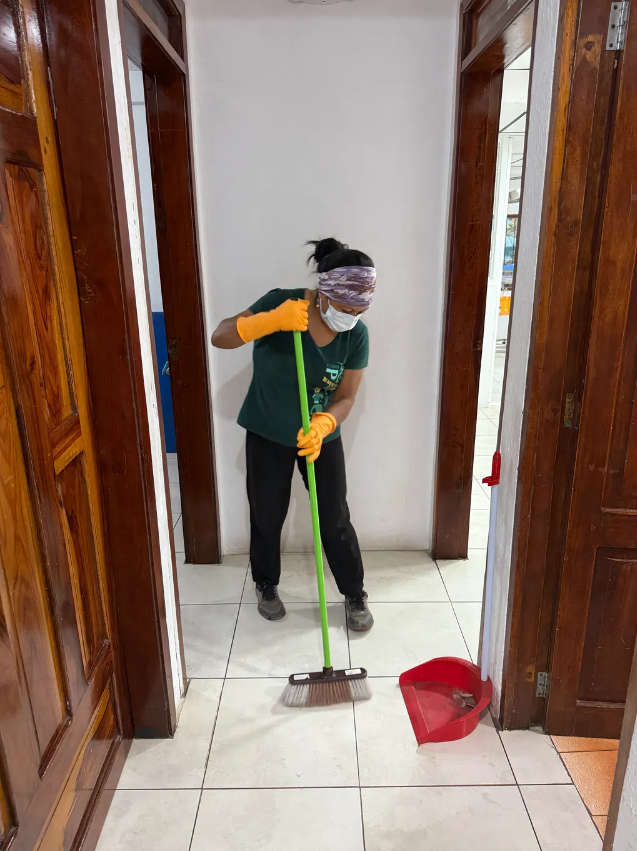
- Sweeping or vacuuming. This should be carried out regularly to remove loose debris, hair and dust. Vacuum systems help minimise aerosolisation, but if a vacuum is not available, sweep slowly and gently to avoid dispersing fine particles into the air.
- Mopping should follow the removal of loose debris, to remove remaining dirt and organic material. A detergent solution should be used initially to ensure surfaces are clean before disinfection.
- Disinfection should be performed after cleaning, using an appropriate disinfectant at the correct dilution and contact time.
- Separate mop heads and cleaning equipment should ideally be used for different areas (e.g. isolation vs general use) to prevent cross-contamination. Mop heads must also be cleaned, disinfected and dried regularly.
- Avoid spreading contamination by working from cleaner areas towards dirtier areas, and ensure floors are allowed to dry fully before animals and staff re-enter.
Surgical preparation area
The surgical preparation area must be thoroughly cleaned throughout the day and in between patients being prepared for surgery.
- All waste materials should be disposed of appropriately.
- Sharps must be disposed of immediately in the sharps bin. If using razors, used razor blades must be carefully removed from the handle and immediately placed into the sharps bin. The razor handle should then be cleaned, disinfected and left ready for use, with no blade attached, so that a new blade can be fitted for the next patient.
- If using electric clippers, these should also be cleaned in between patients.
- Thermometers should be cleaned and disinfected. Thermometers and any other reusable supplies must be returned to their correct storage locations so they are readily available for their next use.
- The preparation table must also be cleaned and disinfected between patients, following the standards outlined above.
- At the end of the day, a full clean should be carried out, including sweeping and mopping the floor, to maintain cleanliness and infection control within the area.
More detailed information on equipment cleaning and disinfection is provided in the next article.
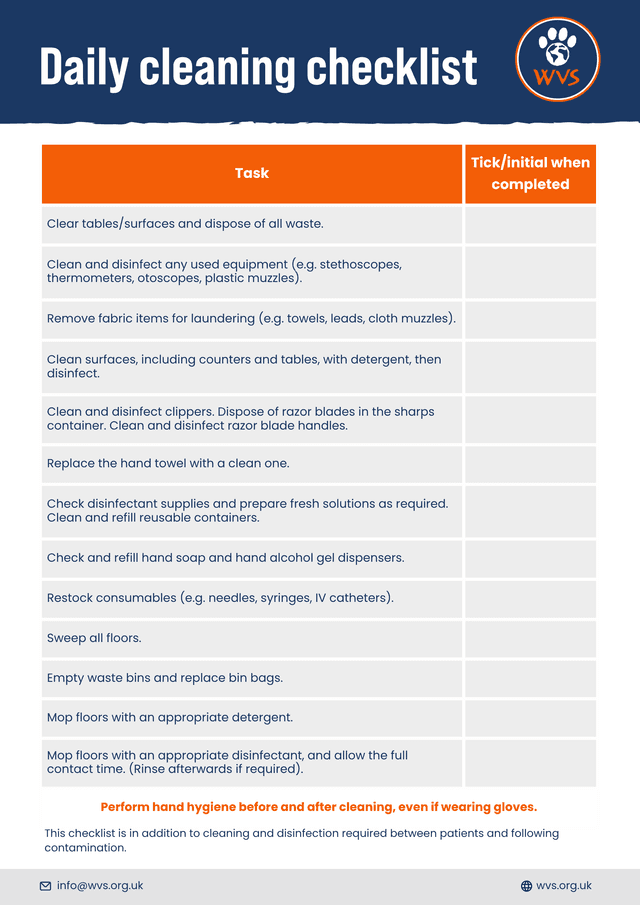
Daily cleaning checklist for clinical areas
Download our poster which provides a checklist for daily cleaning routines.
Download